Dementia Risk: What Can Be Changed? | Presentation Slides
Download the presentation slides and watch Dr. Atif Hashmi’s full guide to modifiable dementia risk and cognitive resilience.
Download the presentation slides and watch Dr. Atif Hashmi’s full guide to modifiable dementia risk and cognitive resilience.
Five sleep problems, what each one is linked to, and which ones are worth acting on. This is the summary post for the series, written to stand on its own.
Apnea and insomnia can be treated, so does treating them protect the brain? Nobody has run the trial that would answer it. What exists is observational data pointing toward benefit and a handful of randomized trials that get cited as proof it fails, when most were never built to detect success.
Three sleep disorders, three different relationships to dementia. Apnea and insomnia are treatable conditions that wire into the brain's overnight clearance. REM sleep behavior disorder is not a habit or a risk factor at all, but an early sign of a disease already underway.
During deep sleep, the brain clears out metabolic waste, including the amyloid protein tied to Alzheimer's. It is one of the most compelling mechanisms in brain health, and one of the most overstated. Here is what the glymphatic system actually does, and what it cannot yet prove in people.
Sleep is the second pillar, and one of the most confusing. Both too little and too much sleep track with higher dementia risk, and cause runs in both directions. This series works through what the evidence on duration, quality, and timing actually supports, starting with why more is not safer.
If you carry APOE4, the strongest genetic risk factor for Alzheimer's, does exercise protect your brain the same way, more, or less? The evidence suggests the relationship may differ for carriers, but the signal is thinner than the confident headlines imply. Here is what actually holds up.
After nine posts taking the evidence apart, here is what survives, and what it means for how you live. Not the headline promise that exercise prevents dementia, but a smaller, sturdier conclusion about what movement can and cannot do for the aging brain, and how to act on it honestly.
After all the trials, the most practical question is the hardest to answer cleanly: how much exercise, and how intense, actually matters for the brain? The dose evidence points to a moderate floor rather than a high ceiling, and to consistency over intensity, then it runs out faster than expected.
Exercise alone kept coming up short in the trials. So researchers stopped testing it in isolation and changed diet, activity, mental engagement, and blood pressure together. That is where the first genuinely positive prevention trials appeared, and where the picture finally starts to turn.
The observational case was strong but confounded. So researchers ran the clean test: large randomized trials of exercise by itself, measured against real cognitive decline, before anyone added diet or mental training. The bigger and stricter the trial, the smaller the effect got.
Every study so far shared one weakness: people chose whether to exercise. So does activity protect the brain, or do the people destined to stay sharp simply stay active longer? Two studies were built to tell the difference, and their answer is sobering.
Brain Health
The famous walking studies never replicated, but one form of exercise did move both cognition and brain structure together: lifting weights, in people already showing mild cognitive impairment. Here is the strongest single signal in the whole pillar, described precisely, and where it stops.
Brain Health
The famous 2011 finding that walking grew the hippocampus faced the test every result must pass: could another team reproduce it? Across the replication decade, the larger and longer trials cut it down to its honest size. Exercise did not rebuild the aging brain, but it slowed what age takes.
Brain Health
For the first time, researchers randomized older adults to exercise and looked straight at the brain. A year of walking appeared to grow the hippocampus by two percent, the most cited exercise-and-brain finding ever published. Here is what it showed, and what it left unsettled.
Brain Health
By 2005, researchers knew active people got less dementia but couldn't prove exercise was the cause. Two cohort studies tried to design around that problem by measuring activity decades before diagnosis. Here is how well it worked, and where it still fell short.
Brain Health
The five-pillar framework begins with physical activity. This series works through the evidence in the order it arrived, starting at the turn of the millennium with the early cohort studies that made the case that active people get less dementia, and why that link was never proof of cause.
Brain Health
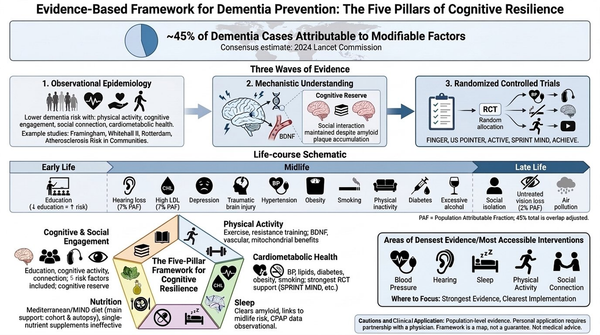
Most brain-health advice is a mix of good evidence and confident guesswork. This publication separates the two, one modifiable risk factor at a time. Here is the five-pillar framework it uses, drawn from the largest prevention studies, and the standard of proof each pillar will be held to.