
The Sleep Evidence, Part 1: How Much Sleep, and How Well?
Sleep is the second pillar, and one of the most confusing. Both too little and too much sleep track with higher dementia risk, and cause runs in both directions. This series works through what the evidence on duration, quality, and timing actually supports, starting with why more is not safer.
The essentials
Dementia risk is lowest around seven hours of sleep, and rises on both sides, with long sleep the steeper side.Two large reviews agree on that U-shape, though they measure slightly different outcomes.Short sleep shows its clearest signal in midlife, and it is not just an artifact of self-report.Over long follow-up the short-sleep link fades, which points to early disease disrupting sleep rather than sleep causing disease.Long sleep looks more like a marker of a changing brain than a lever you can pull.The overall quality of your sleep, not just the hours, tracks with risk.The timing of your daily rhythm is a third factor, separate from how much or how well you sleep.Starting earlier in life seems to matter more.The honest takeaway is to aim for adequate, good-quality sleep, not a perfect number.
The U-shaped curve
Across large studies, dementia risk is lowest at around seven hours of sleep a night and rises on both sides of that. Drawn out, the shape is a U, with seven hours at the bottom.
Two recent syntheses give the clearest picture. A meta-analysis of 17 cohort studies1 covering more than 1.3 million people found short sleep, under seven hours, linked to about 18 percent higher dementia risk, and long sleep, over eight hours, to about 28 percent higher. A larger analysis of 49 cohorts2, covering more than ten million people, found the same lopsided shape, with long sleep again carrying the bigger signal.
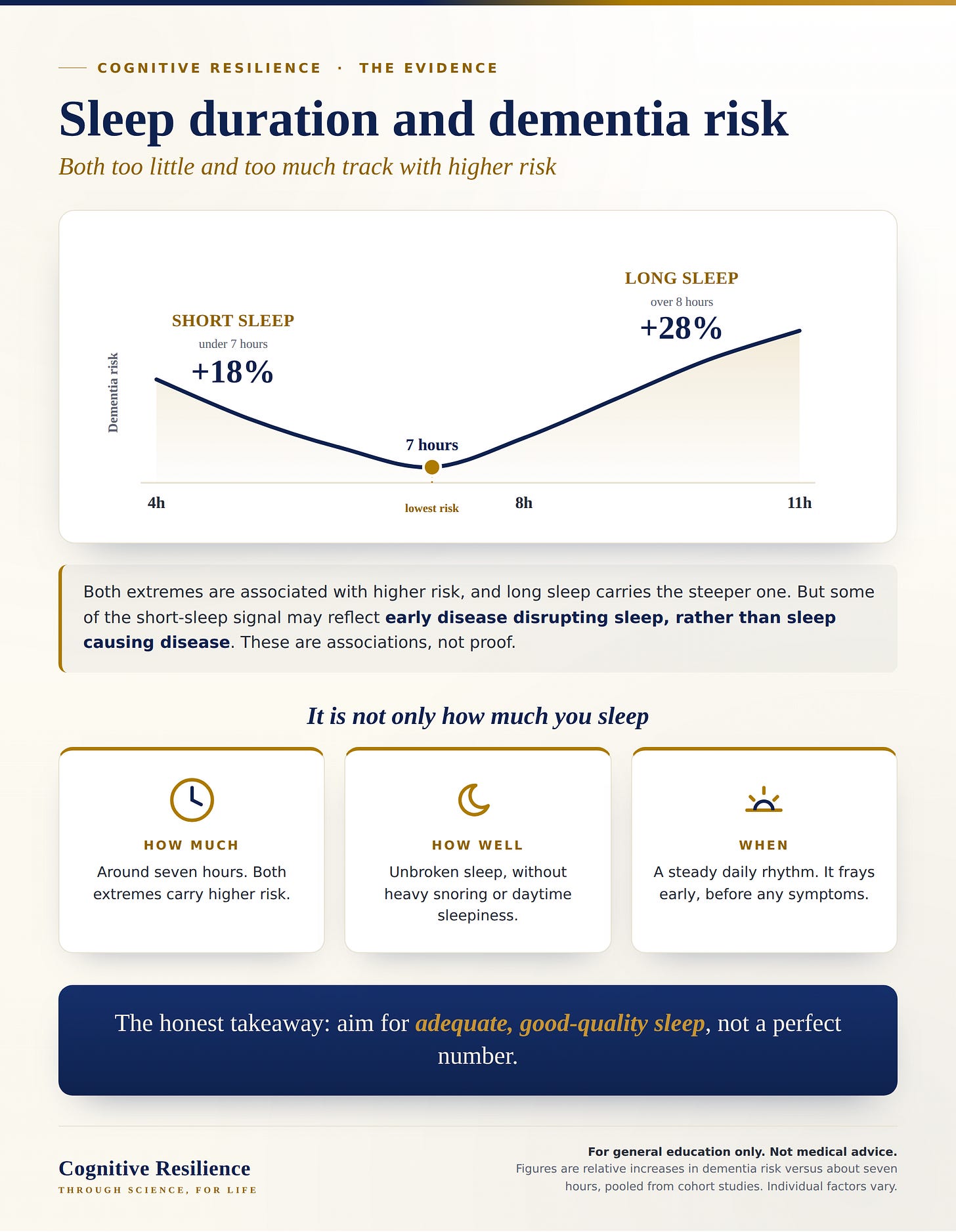
One distinction matters before those numbers travel too far. The larger study measured cognitive decline broadly, not only diagnosed dementia, while the first measured dementia specifically. They point the same way, which is reassuring, but they are not measuring quite the same thing. What holds across both is the shape: both extremes track with higher risk, and the long side is steeper.
Short sleep, and why midlife is where it shows
The strongest evidence on short sleep comes from following people for decades, starting before old age. The Whitehall II study3 tracked nearly 8,000 British civil servants for 25 years, and sleeping six hours or less at age 50 was linked to a 22 percent higher risk of later dementia.
The association held at 60 and weakened at 70. People who slept short consistently across all three decades carried about 30 percent higher risk than those who consistently slept a normal amount, even after accounting for heart, metabolic, and mental health factors.
Most sleep research relies on people reporting their own hours, which is imprecise, and that is a fair objection to all of it. Whitehall II is useful here because a subset wore movement trackers, and the objectively measured short sleepers showed an even larger association. In this group, at least, the signal was not simply a quirk of self-report.
The puzzle at the center
Here is what most people get backwards about sleep and dementia. Short sleep in midlife is linked to more dementia, but in studies that follow people for more than ten years, that link mostly disappears.
That fade is the whole clue. Dementia builds in the brain for a decade or two before it is diagnosed, so if short sleep genuinely drove the disease, its effect should not vanish the longer researchers watch. The likelier explanation is the reverse: a brain already changing, quietly disrupting sleep years ahead of any symptoms. Some of what looks like bad sleep causing dementia may be early dementia causing bad sleep.
This is why a meta-analysis that split studies by follow-up length4 matters. Short sleep predicted dementia in the shorter studies, but not in the ones that followed people past ten years. Long sleep behaved differently, holding its link even over long follow-up. The authors concluded that short sleep may be an early symptom, while long sleep looks more like a risk factor in its own right.
Hold all of it loosely. The evidence here is mixed and of modest quality, most of it self-reported, with real room for confounding. The point is not that short sleep is harmless. It is that the data do not cleanly support the comforting story where fixing your hours fixes your risk.
Long sleep is more likely a signal than a lever
Sleeping more is not the safe direction. Both too little and too much sleep are linked to higher dementia risk, and the long-sleep side is the steeper one.
But “I sleep nine hours” often just means “I’m in bed nine hours,” some of it lying awake. Time in bed is not the same as time asleep, and part of what gets counted as long sleep may really be poor, broken sleep. Long sleep looks less like a habit to fix and more like a signal worth paying attention to.
That does not make it useless information. Someone whose sleep is drifting longer over the years is worth a closer look. It just points toward looking underneath the sleep, rather than at the number itself.
The pattern over time may matter as much as any single night
A single night tells you less than the direction of travel. Whether someone’s sleep is holding steady, or drifting shorter or longer over the years, carries information a one-time measurement misses.
The larger sleep-duration review found that drifting from a normal amount into long sleep was among the highest-risk trajectories of all. But the marker-versus-cause question returns right here, because a lengthening sleep pattern may be the early footprint of a changing brain rather than something worth correcting on its own. Either way, a meaningful drift, especially toward much longer sleep, is worth noticing rather than ignoring.
The overall quality of your sleep, not just the hours
Duration is only one part of the picture, and maybe not the most useful one. A large UK Biobank study5 built a simple five-point sleep score from sleeping seven to eight hours, being a morning type, and having no frequent insomnia, no snoring, and no daytime sleepiness. Each additional point was linked to about 7 percent lower dementia risk, and people with a perfect score had about a quarter lower risk than those at the bottom.
The components carry unequal weight. Sleeping seven to eight hours mattered on its own, but not being troubled by daytime sleepiness carried the most weight of any single item, more than duration itself. How well you sleep does at least as much work as how long.
One caveat covers all of this. It is observational. Good sleepers differ from poor ones in many ways, and no study of this kind can fully separate the sleep from everything that travels with it.
Starting earlier seems to matter more
The same UK Biobank analysis5 found the benefit was larger in its younger participants, aged 40 to 55, than in those aged 56 to 64, which fits a broader pattern where modifiable factors count for more earlier in life.
One caveat keeps this honest. Everyone in that comparison was middle-aged, so the finding is that the payoff was bigger in the younger middle-aged group, not that sleep matters in midlife and stops mattering later. Read straight, it is a simple case for caring about your sleep sooner rather than later.
Timing is a third factor, separate from how much and how well
Beyond how long and how well you sleep is a third thing: how sharply your body separates day from night. A healthy daily rhythm has a strong contrast, clearly active and moving during the day, clearly still and resting at night. That contrast tends to flatten with age, and it flattens further with disease.
In a community cohort of older adults6, the people whose day-night contrast was weakest, low daytime activity blurring into a restless night, had the highest dementia risk, and this was the strongest circadian signal in the study. A choppy, fragmented rhythm and a daily activity peak that arrived later than usual also predicted higher risk. The link held even after setting aside people who already had mild cognitive impairment, which makes it harder to dismiss as simply an early symptom.
The disruption seems to begin early. In a separate study of cognitively normal adults7, those whose brains already carried the earliest Alzheimer’s changes had more fragmented daily rhythms than those who did not, and the more advanced those changes were, the choppier the rhythm. Everyone in that group was still symptom-free.
Two honest caveats. Aging flattens and fragments these rhythms on its own, so this is not purely a disease signal, early disease adds to it. And this is a younger area of research than the duration work. But the practical idea is simple: a crisp, strong day-night rhythm looks protective, and a flat, blurred one does not.
Where this leaves things
The duration research hands you a number, seven hours, then spends the rest of its findings complicating it. Short sleep in midlife tracks with later dementia, but the signal fades over long follow-up in a way that points to early disease more than simple cause. Long sleep carries a bigger association, but one that looks more like a marker than a dial. Underneath the number, the sturdier signals are the overall quality of sleep and the steadiness of the daily rhythm.
So the honest read is not to hit seven hours exactly. It is that adequate, good-quality sleep is what the evidence supports, and that a drift toward much longer or more fragmented sleep is worth noticing. None of this has been shown to prevent dementia in a trial, and this piece is about association, not proof.
What comes next is the mechanism: what sleep is doing for the brain overnight that might explain why any of these links exist at all.
References
- Oye-Somefun A, Mirzadeh P, Gao-Kang J, Rotondi M, Kuk JL, Tamim H, Ardern CI. The relationships between physical activity, sedentary behaviour, sleep, and dementia: a systematic review and meta-analysis of cohort studies. PLoS One. 2026;21(4):e0343621. https://doi.org/10.1371/journal.pone.0343621
- Yang Q, Li S, Yang Y, Lin X, Yang M, Tian C, Mao J. Prolonged sleep duration as a predictor of cognitive decline: a meta-analysis encompassing 49 cohort studies. Neurosci Biobehav Rev. 2024;164:105817. https://doi.org/10.1016/j.neubiorev.2024.105817
- Sabia S, Fayosse A, Dumurgier J, et al. Association of sleep duration in middle and old age with incidence of dementia. Nat Commun. 2021;12:2289. https://doi.org/10.1038/s41467-021-22354-2
- Howard C, Mukadam N, Hui EK, Livingston G. The effects of sleep duration on the risk of dementia incidence in short and long follow-up studies: a systematic review and meta-analysis. Sleep Med. 2024;124:522-530. https://doi.org/10.1016/j.sleep.2024.10.022
- Wei T, Chang J, Zhao Y, et al. Associations of adherence to a healthy sleep pattern with the dementia risk in the UK Biobank. Alzheimers Res Ther. 2025;17:213. https://doi.org/10.1186/s13195-025-01864-x
- Wang W, Wanigatunga AA, Etzkorn LH, et al. Association between circadian rest-activity rhythms and incident dementia in older adults: the Atherosclerosis Risk in Communities Study. Neurology. 2026;106(2):e214513. https://doi.org/10.1212/WNL.0000000000214513
- Musiek ES, Bhimasani M, Zangrilli MA, Morris JC, Holtzman DM, Ju YS. Circadian rest-activity pattern changes in aging and preclinical Alzheimer disease. JAMA Neurol. 2018;75(5):582-590. https://doi.org/10.1001/jamaneurol.2017.4719
This article is for general education, not medical advice, and reading it does not create a physician-patient relationship. It reports research findings, most of them observational, which show associations rather than proof of cause. Before changing anything about your sleep, medications, or health, talk with your own clinician, who can weigh what applies to you.