
The Sleep Evidence, Part 3: Sleep Apnea, Insomnia, and REM Sleep Behavior Disorder
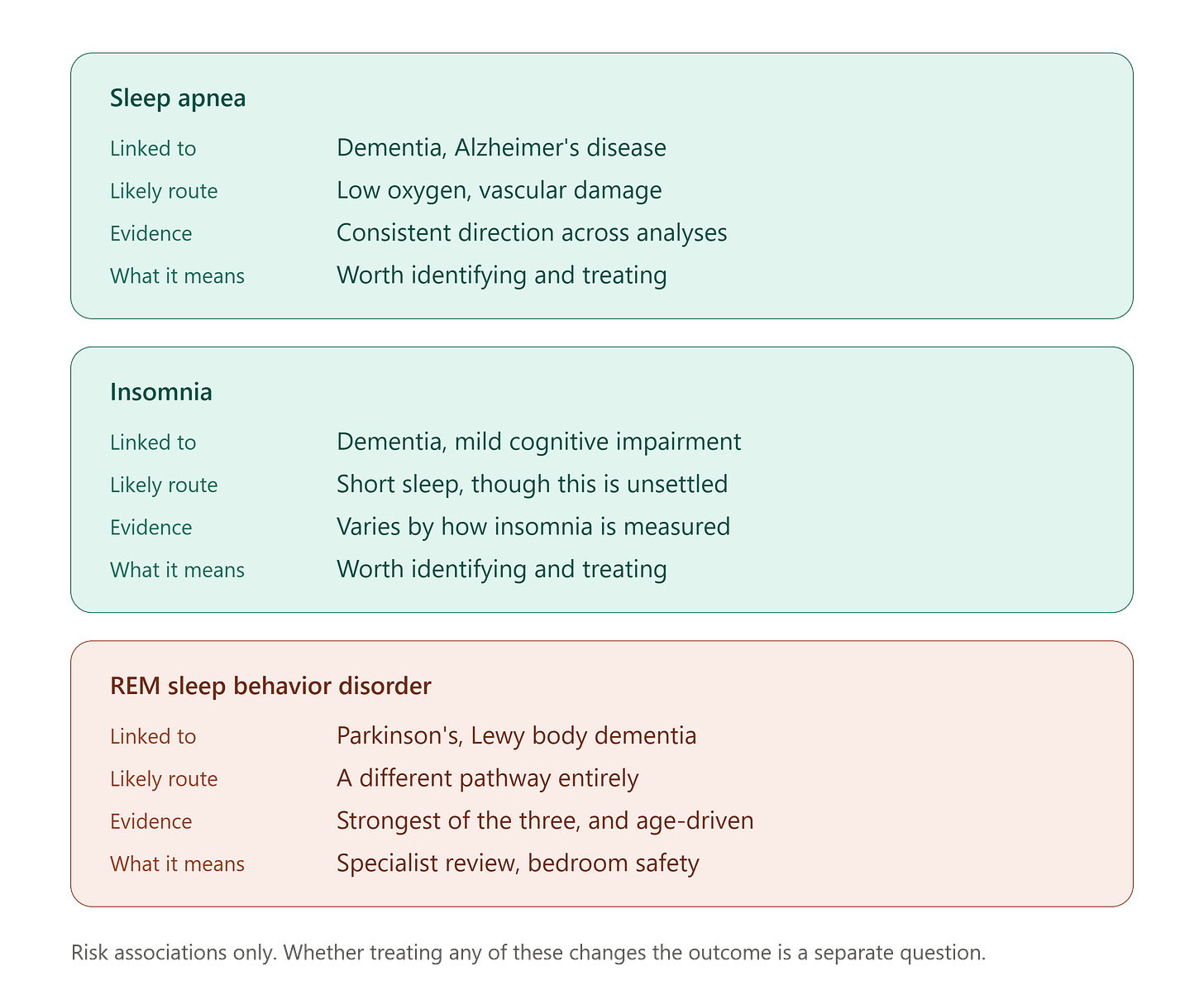
Three sleep disorders, three different relationships to dementia. Apnea and insomnia are treatable conditions that wire into the brain's overnight clearance. REM sleep behavior disorder is not a habit or a risk factor at all, but an early sign of a disease already underway.
The essentials
Obstructive sleep apnea is linked to higher dementia risk. Three pooled analyses put the Alzheimer’s figure between a quarter and a half higher, and the analyses that measured apnea specifically put all-cause dementia at roughly a third higher.
The damage appears to track low blood oxygen rather than the fragmenting of sleep. Imaging ties those oxygen drops to small vessel disease and to thinning in memory-related regions, though these imaging studies are small.
Apnea also tracks with reduced fluid movement along the brain’s blood vessels, which connects it to the clearance mechanism from the last post. That measure is a surrogate, not a direct picture of clearance.
Insomnia is linked to higher risk in several large analyses but not in all of them. Estimates run from no association at all up to about forty percent higher, and much of that spread tracks how insomnia was defined and measured.
In one cohort, the brain markers attached to people reporting less sleep than usual rather than to insomnia in general. A larger cohort sorted people by how many hours they slept and found the opposite arrangement, so which sleep pattern carries the risk is unsettled.
The genetic evidence on insomnia and dementia is mixed, so causation remains an open question for both disorders.
REM sleep behavior disorder belongs in a different category. It predicts Parkinson’s disease and Lewy body dementia rather than Alzheimer’s, and it does so far more strongly than any habit or exposure in this series.
That prediction depends heavily on age at diagnosis. It is high in people diagnosed after seventy and low in those diagnosed before fifty.
Nothing is known to change the course of REM sleep behavior disorder. What can be acted on is bedroom safety, and the reason to recognize it is early neurological evaluation.
This post is about risk only. Whether treating any of these conditions changes the outcome is the subject of the next post.
The last post made a simple case. For the brain’s overnight cleaning, continuity matters more than chasing any single stage of sleep. This post turns to the conditions that break that continuity.
Two of them can be treated. The third is not a habit or a risk factor at all. It is an early sign of a disease already underway, and it carries the clearest signal of the three.
A note on what this post covers. It is about risk: what each disorder is linked to, and how strongly. Whether treating them changes the outcome is a separate question with its own evidence, and it is the subject of the next post. The two questions rarely have the same answer, and running them together is one of the easiest ways to overstate both.
Why sleep apnea comes first
Obstructive sleep apnea leads, though not because it is the most dangerous of the three. It leads for three practical reasons: it is common, its severity can be measured, and it connects directly to the clearance system described in the last post.
The link to dementia holds up across large pooled analyses. For Alzheimer’s disease, one analysis, a second, and a third all land in a narrow band, each putting the risk somewhere between a quarter and a half higher in people with apnea. For all-cause dementia the picture is less tidy. The two analyses that looked at apnea on its own put the risk at roughly a third higher. The second analysis came in lower, but it had pooled apnea together with other breathing disorders and relied mostly on people reporting their own symptoms instead of on sleep studies. Loose measurement tends to shrink a real effect, so a smaller figure is what that design would predict.
The third analysis reported close to double the risk of Lewy body dementia. That estimate rests on a single cohort with a wide margin of uncertainty, so it sits in the worth-watching column for now. For vascular dementia, none of these analyses found a significant association.
All of this comes from following large groups of people over years. That kind of study can establish an association. It cannot establish that apnea causes the dementia.
Brain imaging adds something the statistics cannot, because it points toward a specific mechanism. Apnea does two things to sleep at once. It lowers blood oxygen, and it breaks sleep into fragments through repeated arousals. Those two disturbances leave different marks.
In 83 older adults at risk for dementia, it was the drops in oxygen, not the fragmentation, that tracked with thinning in the temporal lobe, the region that anchors memory, and thinner tissue there went with worse verbal learning. The oxygen measure did not track directly with memory scores, so the pathway remains plausible without being demonstrated. In that same study, the standard severity index used in clinics, the apnea-hypopnea index on its own, showed no association with cortical thickness anywhere.
More recent work has sketched how the damage might happen. In a study of 37 older adults, low oxygen during dreaming sleep tracked with damage in the frontal white matter, and that damage in turn tracked with thinning in a memory-critical part of the temporal lobe. The authors call it a candidate mechanism, which is the right word for a sample that size.
Apnea’s link to white matter damage itself rests on firmer ground. Both the apnea-hypopnea index and the oxygen desaturation index have been tied to white matter damage in general-population scans. In that study of 529 adults, apnea showed a stronger association with white matter damage than diabetes, smoking, or cholesterol did, and it held up after adjustment for all of them.
One thread runs straight back to the last post. In a study of more than a thousand people scanned twice across four years, worse apnea tracked with a decline in fluid movement along the brain’s blood vessels. That decline statistically accounted for part of the decline in visual memory that came with it.
This measure is a surrogate, the same imaging proxy flagged last time as an inference about the clearance pump, not a picture of it. So it sits a step below the mechanism it points toward. Even so, it tells the same story from the other end. When the overnight flushing is impaired, proteins and vascular wear accumulate, and apnea is one of the things that impairs it.
Apnea is common and it is treatable, which raises an obvious question. Does treating it protect the brain? That question has its own evidence, and it is where the next post begins.
Insomnia, and the part that short sleep plays
Insomnia is the second treatable condition, though the evidence here is less uniform than it is for apnea. One large pooled analysis put the dementia risk in people with insomnia at about a third higher. An independent long-running cohort at the Mayo Clinic found roughly forty percent higher risk of mild cognitive impairment or dementia. A third analysis, pooling a larger set of studies, found a smaller increase of about thirteen percent.
Those authors translated their findings into terms a reader can picture. The higher risk of developing impairment came to about what an extra three and a half years of age would carry. Separately, among participants who were cognitively normal at the start, the faster year-on-year slide in test scores came to roughly sixty percent of the yearly decline seen in people who carry the APOE4 gene.
Underneath that headline number is a more specific finding. In the Mayo cohort, the brain markers did not attach to insomnia in general. They attached to the people who reported sleeping less than usual. That subgroup already carried more white matter damage and more amyloid at the first scan. The people who reported sleeping more than usual had less white matter damage. But insomnia did not predict how fast either marker accumulated over the following years.
On that reading, the trouble has less to do with lying awake than with the hours of sleep that go missing. That is also the version of insomnia that connects back to the clearance mechanism from the last post.
That pattern rests on a single cohort. A separate long-running study sorted people by how many hours they reported sleeping and found the reverse arrangement, with insomnia tracking risk among normal sleepers rather than short sleepers. The two studies asked somewhat different questions, so they do not cancel each other. But which sleep pattern carries the risk is not settled.
One more observation from the pooled analyses is worth having. When insomnia was identified by objective measurement rather than by self-report, the association with cognitive problems was both larger and more consistent across studies. Most of the underlying research relies on self-report, and imprecise measurement tends to wash out a real signal. So these pooled numbers may understate the association rather than overstate it.
That measurement problem may also explain the largest study in this whole area. In half a million UK adults followed for thirteen years, insomnia was identified by a single survey question, and it showed no link to all-cause dementia once vascular risk factors were accounted for. It was the only sleep measure in that study to lose its association after adjustment, and for Alzheimer’s disease specifically it pointed in the protective direction. Whether that reflects something real or the bluntness of the question is not resolved.
Two limits belong alongside all of this. The first is direction. Early brain changes can disturb sleep years before anything is diagnosed, so some of what looks like insomnia driving decline may be decline announcing itself through insomnia. The journal that published the Mayo study ran a formal comment making exactly that point, and the finding that insomnia did not predict the rate of accumulation fits that reading.
The second limit is genetics, which is where people usually reach for causal proof. Here the evidence is mixed. That same large study found no causal link to dementia, or to the vascular changes in the brain that often accompany it, while confirming a causal link to stroke. A separate genetic analysis found a positive link to Alzheimer’s, but an imprecise one with a wide confidence interval. That mixture neither confirms cause nor cancels what the cohorts found. It leaves the question open. Whether treating insomnia changes any of this belongs, again, to the next post.
REM sleep behavior disorder, a marker rather than a habit
The third condition does not belong in the same category as the first two.
In REM sleep behavior disorder, the normal muscle paralysis of dreaming sleep fails and people physically act out their dreams, sometimes violently enough to injure themselves or a bed partner. Taken on its own it is a treatable sleep problem. Its significance lies in what it goes on to predict.
In the largest study of the disorder, a collaboration across two dozen centers, people with the isolated form converted to a diagnosed neurodegenerative disease at about six percent per year. By the twelve-year mark, nearly three quarters had converted. No lifestyle exposure anywhere in this series predicts neurodegeneration that cleanly. These figures come from people diagnosed in specialist sleep centers. Population studies based on questionnaires have not found the same signal.
Those numbers are also an average across a wide age range, and age at diagnosis changes them a great deal. In a separate cohort, people diagnosed after seventy converted at about six percent per year, while those diagnosed before fifty converted at a small fraction of that, with almost none converting over fourteen years. The high figures belong to the older end of the range.
That signal points somewhere specific. The disorder is a forerunner of the synucleinopathies, meaning Parkinson’s disease and Lewy body dementia in roughly equal measure, and it reaches them by a different biological route than the amyloid story running through the rest of these posts. It marks a disease process that has already started, which is a different thing from a risk a person carries into the future.
The risk can also be graded. Within that same cohort, abnormal movement testing, a reduced sense of smell, early cognitive impairment, and an abnormal dopamine scan each marked faster conversion. Insomnia and apnea, the two disorders this post opened with, did not predict conversion. This disorder stands apart from them on every measure the study examined.
That last point explains why it is not simply a fourth item for a personal checklist. Nothing is currently known to change its course, so it is not something a person optimizes through habits. In the medical literature it functions as a reason for early recognition and neurological evaluation. It identifies people who could one day be candidates for treatments aimed at the underlying disease, well before the familiar signs appear.
There is one exception, and it concerns safety. Because dream enactment can injure the sleeper or a bed partner, clinical guidelines advise making the bedroom safer: removing weapons from the bedside, firearms above all, padding or clearing sharp furniture and headboards, putting a mat beside the bed, and sleeping apart when episodes are severe and not yet controlled. That advice is about tonight. It does nothing to change what the disorder predicts.
Three disorders, three different responses
Seen together, the three conditions call for three different responses. Apnea and insomnia can both be identified and treated, and both wire into the clearance biology from the last post. Apnea through low oxygen and vascular wear, insomnia through the missing hours of short sleep.
REM sleep behavior disorder sits outside that frame. It is the strongest predictor of the three, and no change in habits addresses it. In the literature its significance lies in prompting specialist evaluation. The bedroom can be made safer tonight. The trajectory of the disease is a separate matter.
What the evidence shows about treating any of these conditions, and where that evidence is strong and where it is thin, is the subject of the next post.
Further reading
- Ungvari Z, Fekete M, Lehoczki A, et al. Sleep disorders increase the risk of dementia, Alzheimer’s disease, and cognitive decline: a meta-analysis. GeroScience. 2025;47(3):4899-4920. doi:10.1007/s11357-025-01637-2
- Zhang J, Ou J, Lu X, et al. Sleep disorders and the risk of cognitive decline or dementia: an updated systematic review and meta-analysis of longitudinal studies. Journal of Neurology. 2025;272:689. doi:10.1007/s00415-025-13372-x
- Guay-Gagnon M, Vat S, Forget MF, et al. Sleep apnea and the risk of dementia: a systematic review and meta-analysis. J Sleep Res. 2022;31(5):e13589. doi:10.1111/jsr.13589
- Cross NE, Memarian N, Duffy SL, et al. Structural brain correlates of obstructive sleep apnoea in older adults at risk for dementia. Eur Respir J. 2018;52(1):1800740. doi:10.1183/13993003.00740-2018
- Berisha DE, Rizvi B, Chappel-Farley MG, et al. Association of hypoxemia due to obstructive sleep apnea with white matter hyperintensities and temporal lobe changes in older adults. Neurology. 2025;104(11):e213639. doi:10.1212/WNL.0000000000213639
- Zacharias HU, Weihs A, Habes M, et al. Association between obstructive sleep apnea and brain white matter hyperintensities in a population-based cohort in Germany. JAMA Netw Open. 2021;4(10):e2128225. doi:10.1001/jamanetworkopen.2021.28225
- Lee MH, Lee WJ, Lee SK, Kim S, Siddiquee AT, Hwang YH, Paik SM, Park HJ, Kim JR, Thomas RJ, et al. Impact of sleep apnea on perivascular diffusivity and cognition: a 4-year prospective cohort study. Am J Respir Crit Care Med. 2025;211(12):2382-2392. doi:10.1164/rccm.202411-2221OC
- Carvalho DZ, Kolla BP, McCarter SJ, et al. Associations of chronic insomnia, longitudinal cognitive outcomes, amyloid-PET, and white matter changes in cognitively normal older adults. Neurology. 2025;105(7):e214155. doi:10.1212/WNL.0000000000214155
- Tan X, Åkerstedt T, Lagerros YT, et al. Interactive association between insomnia symptoms and sleep duration for the risk of dementia: a prospective study in the Swedish National March Cohort. Age and Ageing. 2023;52(9):afad163. doi:10.1093/ageing/afad163
- Guo C, Harshfield EL, Markus HS. Sleep characteristics and risk of stroke and dementia: an observational and Mendelian randomization study. Neurology. 2024;102(5):e209141. PMID:38350061
- Alexandres CA, McCarter SJ, Tabatabai GM, et al. Phenoconversion in women and men with isolated REM sleep behavior disorder: a retrospective cohort study. Neurology. 2024;103(10):e209993. doi:10.1212/WNL.0000000000209993
- Howell M, Avidan AY, Foldvary-Schaefer N, et al. Management of REM sleep behavior disorder: an American Academy of Sleep Medicine clinical practice guideline. J Clin Sleep Med. 2023;19(4):759-768. doi:10.5664/jcsm.10424
- Postuma RB, Iranzo A, Hu M, et al. Risk and predictors of dementia and parkinsonism in idiopathic REM sleep behaviour disorder: a multicentre study. Brain. 2019;142(3):744-759. doi:10.1093/brain/awz030
How I make this
I am a board-certified neurologist. I pick the topic, then find the research through Google Scholar, PubMed, and AI tools like OpenEvidence. I give the full texts to AI for summarizing, then have those summaries re-checked against the source papers before I use them. From there I decide which findings belong in the post, and AI writes the first draft. I read the full papers, or the sections that matter, or at minimum the key findings and numbers. I then review the draft against the sources, question what reads wrong, and direct the revisions through several rounds of accuracy, language, and clarity checks. Each post takes me five to seven hours of my own time.
A note on what this is
This post is general education, not medical advice. It describes what research has found across groups of people, which is a different thing from what applies to any one person. Nothing here is a diagnosis, a treatment recommendation, or a substitute for care from your own physician. Reading it does not create a physician-patient relationship. If you think you may have a sleep disorder, or you are weighing what to do about one, that conversation belongs with a clinician who knows your history. Do not start, stop, or change any medication or treatment based on what you read here.