
The Exercise Evidence, Part 9: How Much Exercise, and How Hard?
After all the trials, the most practical question is the hardest to answer cleanly: how much exercise, and how intense, actually matters for the brain? The dose evidence points to a moderate floor rather than a high ceiling, and to consistency over intensity, then it runs out faster than expected.
If you have read this far in the series, you know the honest shape of things.
The strong claim, that exercise prevents dementia, did not survive the trials. What survived is narrower and quieter: exercise is good for the brain in modest, indirect ways, mostly through the heart and blood vessels, and the clearest gains come from a structured, sustained way of living rather than any single workout.
So the practical question becomes: if you are going to exercise for your brain anyway, and you should, how much should you do, and how hard?
This is where people want a number. A target. Ten thousand steps, or 150 minutes, or some threshold that unlocks the benefit.
The honest answer is that the brain does not come with a clean dose. But the evidence does point somewhere useful, as long as you know what kind of evidence it is.
What the big observational studies show
Start with the pattern, because it is real and consistent.
Across very large studies, more activity tracks with less dementia. One analysis pooled twenty-nine studies and nearly one and a half million people, and found that each step up in weekly activity went with meaningfully lower Alzheimer’s risk.
But the shape of that line matters, and it is not straight.
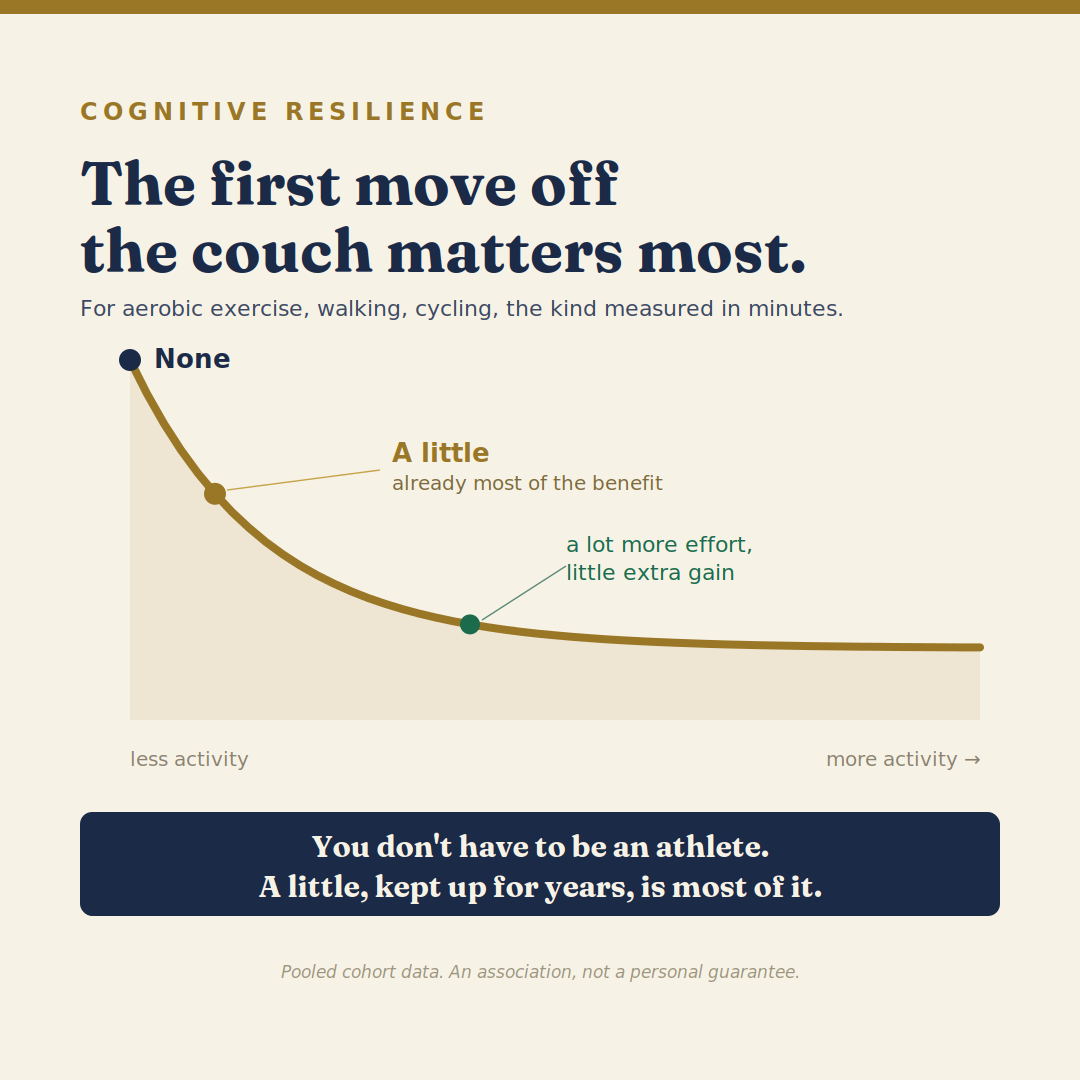
The benefit is steepest right at the bottom, where people go from doing almost nothing to doing a little. It keeps rising for a while, then flattens. Pooled data suggest the curve largely levels off somewhere around three to six hours of activity a week. Past that, more exercise adds little to the measured dementia numbers.
That bottom-end steepness is the encouraging part. In large studies of people wearing activity trackers, even amounts well below the official targets were linked to lower dementia risk. In one big step-count study, about half of the maximum benefit showed up by roughly 3,800 steps a day, well short of the ten thousand people tend to fixate on.
The people doing almost nothing who started doing a little saw the steepest drop. That is the closest thing to a headline the dose research offers: the first move off the couch matters most, and you do not have to become an athlete to get the bulk of it.
Why those numbers come with a warning
Here is the catch, and the whole series has been building it.
All of those figures come from watching people, not assigning them. And we already saw, in the earlier posts, that watching has a trap: the earliest stages of dementia quietly reduce how much people move, years before diagnosis. So some of that clean dose-response line is the disease lowering activity, not activity holding off the disease.
When researchers ran the actual experiments, the large benefit shrank to something much smaller. It did not vanish. Randomized trials do show modest cognitive gains from exercise, real improvements in things like executive function, but small ones. What shrank was the size of the effect, not its existence.
So the dose-response curve is real as a description, and unreliable as a promise. It tells you what active people look like. It does not tell you how much risk you personally buy with each extra walk. The true causal effect is smaller than the observational one, and nobody can hand you a precise number.
That is not a reason to skip the exercise. It is a reason to hold the numbers loosely.
Does intensity help? A surprising hint
If more is better, you might think harder is better too. Push the intensity, get more brain.
The evidence does not support that, and one trial hints at the opposite.
A Norwegian study followed older adults for five years, assigning them either to high-intensity interval training, to moderate steady exercise, or to simply following the national activity guidelines. A subgroup had brain scans throughout.
The surprise: the high-intensity group showed slightly faster shrinkage in a memory-related part of the brain than the comparison groups. The group with the least shrinkage was the one simply following national activity guidelines on their own.
This needs to be held carefully, more carefully than the headline version of it.
It was a small substudy. The comparison group was not a clean moderate-exercise arm, it was a self-directed group doing whatever the guidelines led them to, which varied from person to person. The moderate steady-training group, for its part, showed its own faster shrinkage in a different region of the brain. All the changes stayed within the normal range.
And crucially, none of it produced any difference in actual thinking. No group ended up sharper or duller than another, and over a longer follow-up, baseline fitness predicted brain volume better than which group people had been assigned to.
So this is a hint, not a verdict, and a tangled one. Another small trial found the opposite, a working-memory edge for high-intensity training. Put together, the honest reading is that intensity’s effect on the brain is genuinely unsettled, with conflicting signals and no clear winner. What the evidence does not support is the simple belief that harder is automatically better for the brain.
One exception worth naming
Everything so far is about aerobic exercise, walking, cycling, the kind measured in minutes. Strength training plays by different rules.
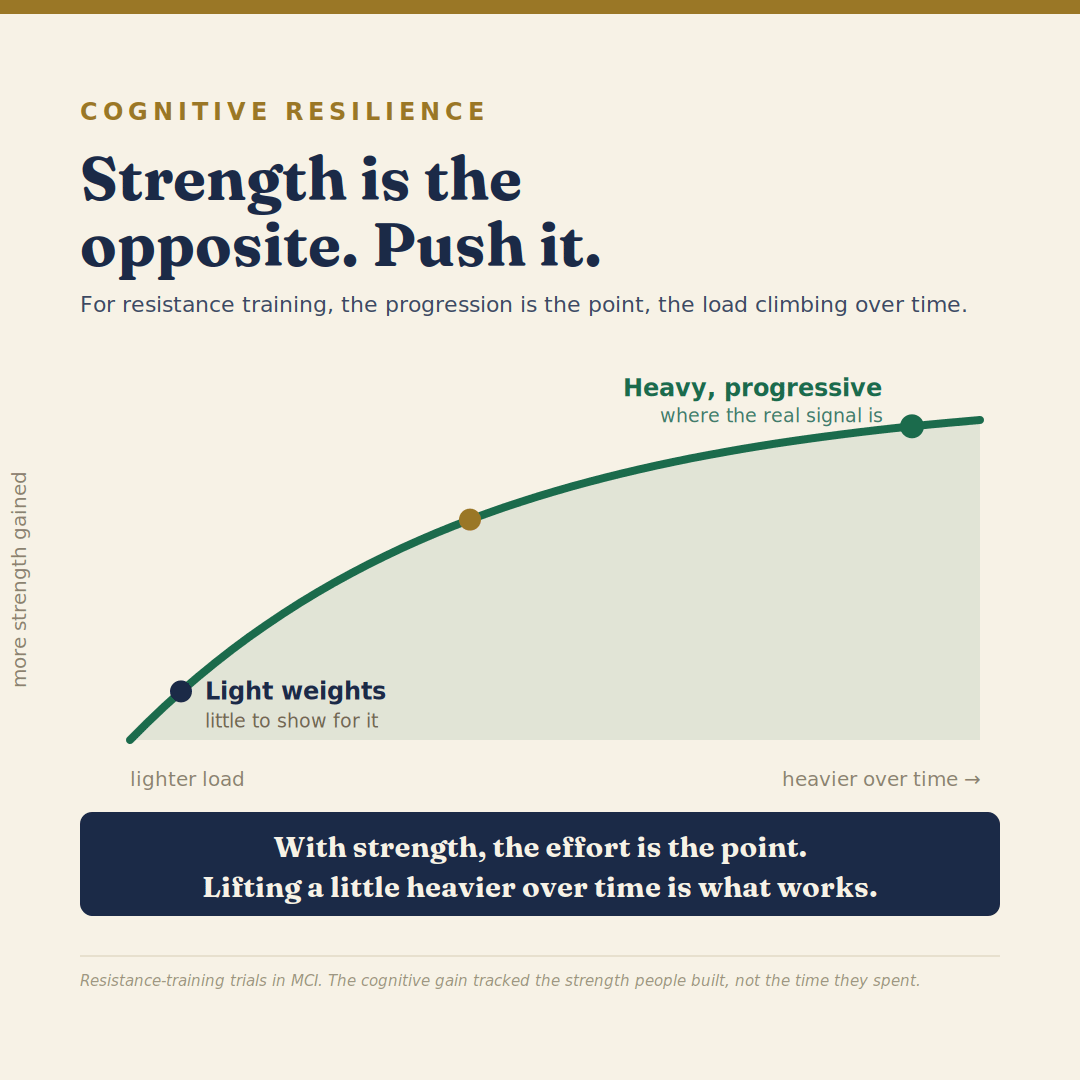
Part 5 covered this in full, so just the dose point here. With resistance training, the intensity is not optional. The trials that showed a real structural brain signal used heavy, progressive load, weight that climbed as people got stronger, two to three times a week. And in the trial with the cleanest brain signal, the cognitive benefit tracked the strength people gained, not the aerobic fitness they gained. The lifting itself, getting measurably stronger, was what carried it.
The exact dose, how heavy and how often, is still being worked out. But the direction is clear: the progression is the part that seems to matter.
So the two kinds of exercise follow opposite dose rules. For aerobic, consistency beats intensity. For strength, the progression is much of the point. Lifting a little heavier over time is not the part to skip. It may be the part that works.
When you do it may matter more than how hard
There is one more thread the dose question tends to miss: age.
A long analysis from the Framingham Heart Study tracked activity across the adult lifespan. Higher activity in midlife, the forties to early sixties, went with substantially lower dementia risk, and in that window, higher intensity appeared to go with lower risk.
In later life, activity still tracked with lower risk, but the intensity stopped mattering. Even light activity carried the benefit.
That pattern fits the rest of the evidence. For an older adult, the message is forgiving: the intensity matters far less than the showing up. For someone middle-aged, it is a quiet argument for building the habit, and a bit of vigor into it, earlier rather than later.
The dose that is actually proven
Step back from the brain for a moment, because the most certain benefit of exercise was never really about the brain.
The cardiovascular dose-response is solid, causal, and well established. Regular activity lowers the risk of heart disease, stroke, and the vascular damage that itself feeds cognitive decline. That is not an association haunted by reverse causation. It is one of the best-supported findings in all of medicine.
And the dose for that is the standard guideline: about 150 minutes a week of moderate activity, or roughly half that if it is vigorous, plus a couple of sessions of strength work.
That number was not invented for the brain. But it is very likely the right number for the brain too, for a simple reason. Much of exercise’s benefit to cognition appears to run through the vascular system, the same plumbing that the guideline amount is proven to protect.
So the dose you can actually stand behind is the ordinary one. Not because a trial proved it preserves memory, but because it reliably protects the system through which most of the brain benefit seems to travel.
So, how much, and how hard?
Pulling the honest threads together.
There is no magic brain number, and anyone who hands you one is reaching past the evidence.
More activity tracks with less dementia, but the biggest gain by far is simply moving from nothing to something. The first few minutes a day are the ones that matter most.
For aerobic exercise, harder is not clearly better for the brain. The evidence on intensity is mixed, and consistency looks more important than effort. For strength training, the opposite holds: progressive load is the active ingredient. Different animals, different rules.
And the dose worth committing to is the standard guideline, around 150 minutes of moderate activity a week plus a couple of strength sessions. Not because it has been proven to prevent dementia, but because it is proven to protect your heart and vessels, and the brain most plausibly benefits along the same road.
The take-home. The brain does not reward precision here. It rewards showing up, at a sustainable intensity, for years. For aerobic work, that means consistency over intensity: the biggest gain is simply going from nothing to something, and the case for pushing to extremes is mixed at best. For strength work, it means progressing the load over time, because that is what drove the real signal.
The dose worth committing to is the ordinary guideline amount, around 150 minutes a week plus some strength work. Not because a trial proved it saves memory, but because it reliably protects the heart and vessels that most of the brain benefit travels through. A little, done consistently, for a long time, is most of what the evidence will honestly promise. That is harder than hitting a step count, and more achievable than the fitness industry makes it sound.
That leaves one last question, the one this whole series has been circling. If the trials are this humbling, what should a person actually do, and what should they reasonably expect? That is the final post.
This is general science writing about published research, not medical advice. Decisions about exercise, particularly for anyone with a memory concern or a medical condition, belong with your own clinician.
References
- Jiang Y, Jin Z, Wang H, et al. A dose-response meta-analysis of physical activity and the risk of Alzheimer’s disease in prospective studies. J Neurol. 2025;272(3):225. https://pubmed.ncbi.nlm.nih.gov/40053161/
- Xu W, Wang HF, Wan Y, et al. Leisure time physical activity and dementia risk: a dose-response meta-analysis of prospective studies. BMJ Open. 2017;7(10):e014706. https://pubmed.ncbi.nlm.nih.gov/29061599/
- Wanigatunga AA, Liu F, Wang H, et al. Daily moderate-to-vigorous physical activity and incident dementia: an accelerometry study. J Am Med Dir Assoc. 2025. Summary
- Reitlo LS, Pani J, Stensvold D, Wisløff U, Håberg AK. Long-term effects of a 5-year randomized controlled exercise trial on brain volumes and cognitive function in older adults: a 4-year post-intervention follow-up study. Sports Med. 2026. https://doi.org/10.1007/s40279-026-02434-3
- Pani J, Reitlo LS, Evensmoen HR, et al. Effect of 5 years of exercise intervention at different intensities on brain structure in older adults from the general population: a Generation 100 substudy. Clin Interv Aging. 2021;16:1485–1501. https://doi.org/10.2147/CIA.S318679
- Northey JM, Cherbuin N, Pumpa KL, Smee DJ, Rattray B. Exercise interventions for cognitive function in adults older than 50: a systematic review with meta-analysis. Br J Sports Med. 2018;52(3):154–160. https://doi.org/10.1136/bjsports-2016-096587
- Marino FR, Lyu C, Li Y, Liu T, Au R, Hwang PH. Physical activity over the adult life course and risk of dementia in the Framingham Heart Study. JAMA Netw Open. 2025;8(11):e2544439. https://doi.org/10.1001/jamanetworkopen.2025.44439