
The Exercise Evidence, Part 5: Is Resistance Training Better for the Brain Than Aerobic?
The famous walking studies never replicated, but one form of exercise did move both cognition and brain structure together: lifting weights, in people already showing mild cognitive impairment. Here is the strongest single signal in the whole pillar, described precisely, and where it stops.
Across the first four parts of this series, a consistent picture emerged. The link between exercise and a healthier aging brain is real and has held up across decades of study. What has not held up is the tidier story underneath it. The famous result that walking rebuilds the brain’s memory center did not replicate, and the longer and larger the trials got, the more the dramatic structural claims shrank. The benefit turned out to be genuine even as the mechanism most people assume for it did not. This post is about the one place the evidence still points to exercise changing the structure of the brain, in people who had already begun to slip, and it came from lifting weights, not the walking everyone pictures.
That exception is the strongest single signal in the entire pillar, and it is narrow enough that it has to be described precisely.
A trial built to a higher standard
The anchor is an Australian trial called SMART, published in 2014. It enrolled 100 older adults with mild cognitive impairment, the stage where memory complaints are real and measurable and often precede dementia, and it was built to a standard most exercise trials never reach.
It was double-blind and double-sham. The comparison groups did sham versions of both interventions, seated calisthenics in place of the weight training and documentary videos in place of the computerized brain training, so neither the participants nor the assessors knew who was in which arm. That design strips out the placebo and expectation effects that inflate softer studies. Participants trained at high intensity two to three times a week for six months and were followed for a further year.
What the training changed
The result was the kind the aerobic trials never produced. After six months, resistance training significantly improved global cognition on the trial’s primary measure, a standard scale called the ADAS-Cog.
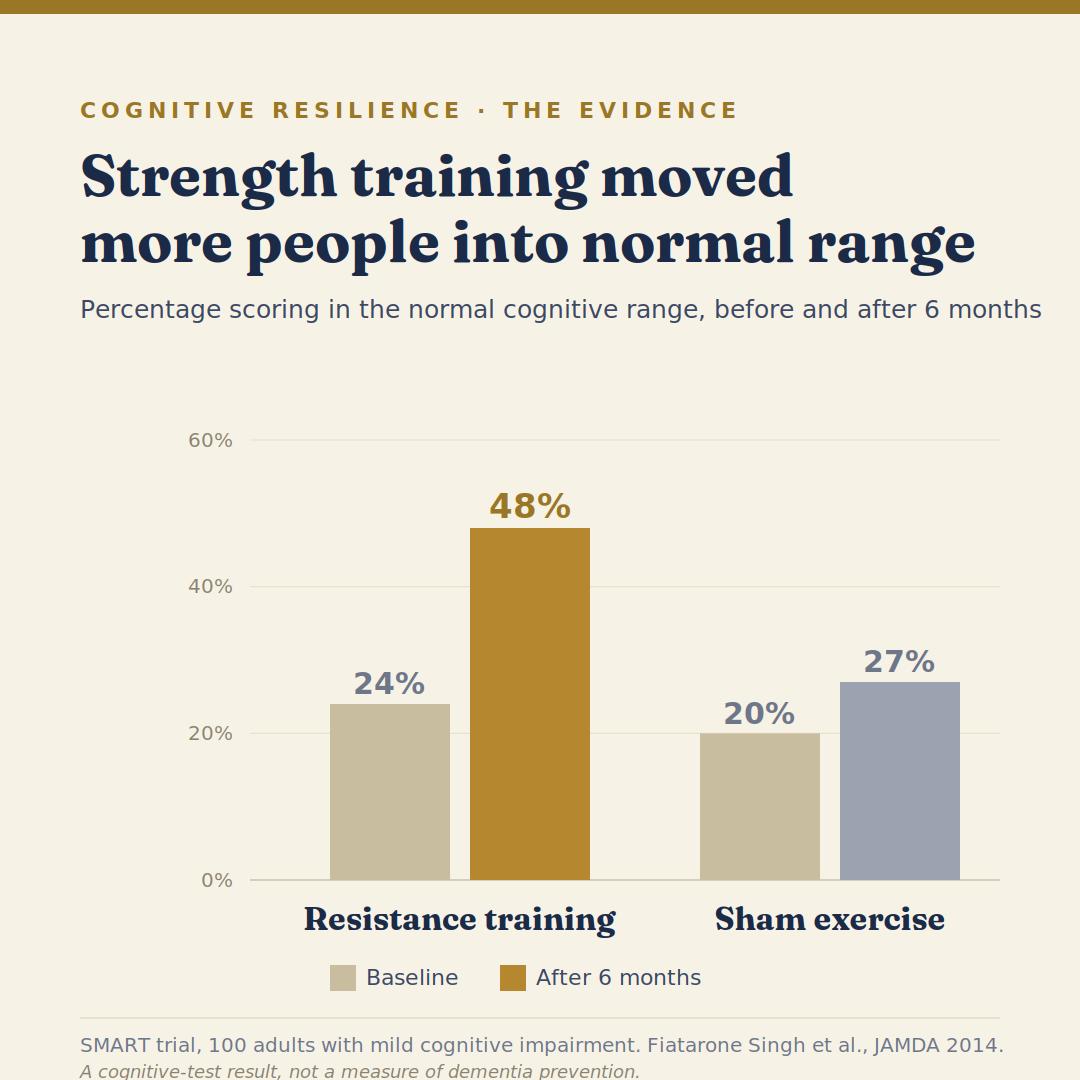
The clearest way to see the size of it is in how many people moved back into the normal range. At baseline, 24 percent of the resistance group scored in the normal range on that scale, and after training 48 percent did. In the sham group the change was small, from 20 to 27 percent. In a group whose scores usually drift downward, a meaningful number had moved back into normal territory. The computerized brain training run alongside the weights did not produce this improvement. It followed the lifting.
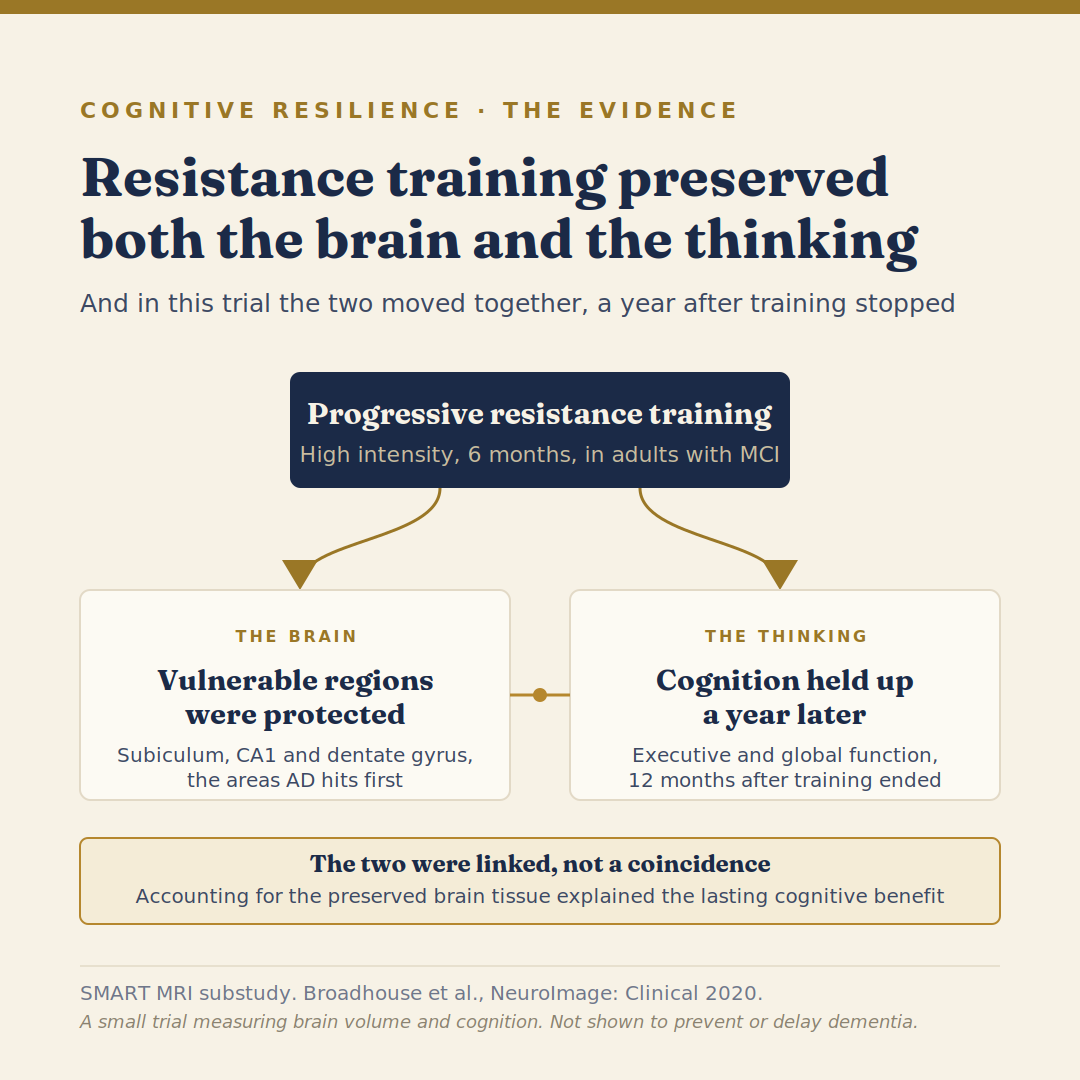
The durability of the effect needs a careful description. The improvement on the primary global scale was clear at six months and faded to a statistical trend by the end of the study. What did persist, a full year after the supervised training stopped, was the benefit to executive and global domain function.
Where the brain itself changed
A subset of these participants were also scanned, and this is where the story separates itself from everything before it. Resistance training protected the specific hippocampal subregions that Alzheimer’s disease attacks first. Long-term atrophy in the left subiculum was eliminated over the eighteen months, and atrophy in the left CA1 and dentate gyrus was slowed, a preservation of roughly two to three percent of volume in regions that otherwise shrink.
The researchers then tested whether the brain change explained the cognitive benefit. They re-ran the cognitive comparison while accounting for how much each person’s subiculum had been preserved, and the resistance group’s advantage over sham disappeared. That is the signature of mediation. The preserved tissue was the most likely route through which the training reached cognition, rather than a coincidence sitting beside it.
This is the link the famous 2011 aerobic result appeared to have and then lost under scrutiny. There, brain volume changed but thinking did not follow. Here the two moved together, and the structural protection held up even after the researchers adjusted for how fit or active people became afterward, which points to a direct effect of the training itself, separate from any later change in lifestyle.
A second lab, in another country
A fair question is whether this is one research group’s finding. It is not. A separate team in Canada showed, in cognitively healthy older women, that resistance training as little as once a week improved selective attention and conflict resolution, a core executive function. The same group then showed in women with probable mild cognitive impairment that resistance training improved that executive measure and associative memory against an active control, while aerobic training in the same trial improved physical fitness without the same cognitive effect.
That is two independent labs in two countries, working in different populations and arriving at the same direction on executive function.
Where the evidence stops
The limits keep this from becoming the kind of overclaim the rest of the series has avoided. These are small trials, tens to low hundreds of people, far short of the thousands that settle a question, and the cognitive effects, while real, were modest in size. They measured cognitive test scores and brain volume, not whether anyone went on to develop dementia, which is the outcome no exercise trial of any kind has yet moved. The SMART authors close by calling for a trial designed specifically to show that resistance training can reduce incident dementia.
The Canadian work carries a complication of its own. In the healthy-women trial, the cognitive gain came alongside a small reduction in whole-brain volume, which the authors flagged as unexplained. It is a useful reminder that the structural story here is specific to the vulnerable hippocampal subfields of people with MCI, and does not extend to brain size in general.
The most recent attempt, a 2025 trial, is best read as encouraging but underpowered. In the higher-risk participants, resistance training produced moderate gains in both a cortical thickness measure and an executive task, and the improvement in thinking tracked with the structural change, the same coupling SMART had shown. The trial was small, though, its pre-registered analyses did not reach significance, and the positive signals came from exploratory comparisons that did not survive correction for multiple testing. The authors read it as a real signal that twelve weeks was likely too short to confirm, and pointed to the longer trials, six months and beyond, where structural benefits have been clearest.
The likely mechanism comes from the same literature. Resistance training raises insulin-like growth factor-1 and related signals released from working muscle that support neuronal health, a muscle-to-brain pathway separate from the vascular route behind aerobic exercise.
What it adds up to
The conclusion is narrow and specific. In people who have already begun to decline, progressive resistance training is the one intervention in this literature where cognition improved, the improvement lasted, and the brain’s most vulnerable memory structures were protected in step with it. It has not been shown to prevent or delay dementia, and the strongest evidence rests on small trials that still need replication at scale. Within those bounds it is the most defensible exercise recommendation the pillar produces.
That still leaves the question the cohorts raised in the first posts and none of these trials can settle. Even where exercise is associated with a better-protected brain, across whole populations and across decades, is the exercise doing the protecting, or is it traveling alongside the people who were going to fare better regardless. The longest follow-up study and the genetic evidence both bear on that question. They are the subject of Part 6.
The take-home:
In the trials, progressive resistance training is the best-supported form of exercise for the aging brain, and the clearest benefits appeared in people already diagnosed with mild cognitive impairment. It has not been shown to prevent dementia. It is the one place in this literature where thinking improved and the brain's vulnerable memory structures were protected at the same time.
This is general science writing about published research, not medical advice. Decisions about exercise, particularly for anyone with a memory concern or a medical condition, belong with your own clinician.
References
- Fiatarone Singh MA, Gates N, Saigal N, et al. The Study of Mental and Resistance Training (SMART) study: resistance training and/or cognitive training in mild cognitive impairment. JAMDA. 2014;15(12):873–880. https://doi.org/10.1016/j.jamda.2014.09.010
- Broadhouse KM, Fiatarone Singh M, Suo C, et al. Hippocampal plasticity underpins long-term cognitive gains from resistance exercise in MCI. NeuroImage: Clinical. 2020;25:102182. https://doi.org/10.1016/j.nicl.2020.102182
- Liu-Ambrose T, Nagamatsu LS, Graf P, et al. Resistance training and executive functions: a 12-month randomized controlled trial. Archives of Internal Medicine. 2010;170(2):170–178. https://doi.org/10.1001/archinternmed.2009.494
- Nagamatsu LS, Handy TC, Hsu CL, et al. Resistance training promotes cognitive and functional brain plasticity in seniors with probable mild cognitive impairment. Archives of Internal Medicine. 2012;172(8):666–668. https://doi.org/10.1001/archinternmed.2012.379
- Kušleikienė S, Ziv G, Vints WAJ, et al. Cognitive gains and cortical thickness changes after 12 weeks of resistance training in older adults with low and high risk of mild cognitive impairment. Brain Research Bulletin. 2025;222:111249. https://doi.org/10.1016/j.brainresbull.2025.111249