
The Exercise Evidence, Part 3: The Trials That Showed Walking Grew the Hippocampus
For the first time, researchers randomized older adults to exercise and looked straight at the brain. A year of walking appeared to grow the hippocampus by two percent, the most cited exercise-and-brain finding ever published. Here is what it showed, and what it left unsettled.
Part 2 ended at the ceiling of observational research. No cohort, however large or long, could assign people to exercise, so none could prove that activity was the cause rather than a marker of an already-healthier life. Breaking through that ceiling needed two things at once: randomize people to exercise or not, and look directly at the brain instead of waiting years for a diagnosis. Two imaging trials from this period did exactly that and produced the most encouraging results the field had seen. Other physical-activity trials from these same years measured thinking rather than brain structure, and those belong to a later part. This one follows the scans.
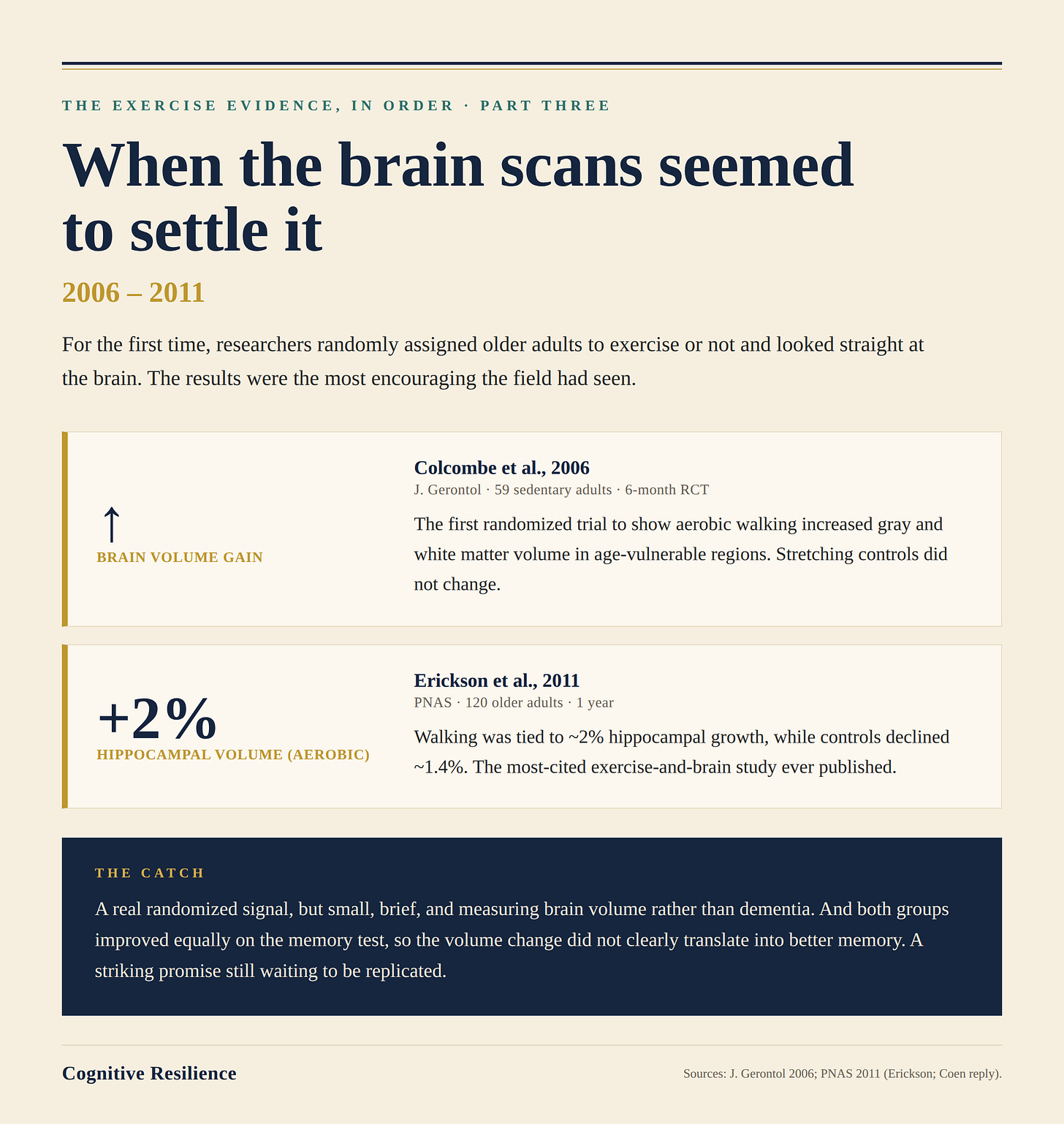
The structural idea did not appear from nowhere. Cross-sectional work in 2003 had already linked higher fitness to less age-related brain-tissue loss, but that was a snapshot, vulnerable to the same confounding as the cohorts. The first randomized test came in 2006, again from a group in Illinois. They randomized 59 healthy but sedentary older adults to six months of either aerobic walking or stretching and toning, then compared brain scans. The walking group gained volume in gray and white matter, in the prefrontal and temporal regions that tend to thin with age. The stretching group did not, and a separate group of younger adults showed no change either way. This is the first randomized evidence that exercise does not merely accompany a healthier brain but physically changes its tissue. It is usually overlooked, because the study that made the idea famous arrived five years later.
That study, published in 2011, is one of the most cited exercise-and-brain papers ever written. The same group randomized 120 older adults to a year of brisk walking or stretching and toning and tracked the hippocampus, the memory structure that shrinks with age and is among the first regions Alzheimer’s attacks. The numbers were striking. The walking group’s hippocampus grew by about 2 percent, while the stretching group’s shrank by about 1.4 percent, roughly a year of normal age-related loss. The change tracked with higher blood levels of BDNF, a protein involved in supporting the growth and survival of neurons. A structure everyone assumed could only decline had, it seemed, been pushed back the other way by walking three times a week.
Step back and see why this was the high point. For the first time the evidence answered the question Parts 1 and 2 could not. The trials were randomized, so the confounding and reverse-causation problems that haunted the cohorts were, in principle, removed. Nobody chose to be active; they were assigned. And the outcome was not a fuzzy diagnosis decades away but a measurable change in brain tissue you could see on a scan. This is the moment the popular version of exercise-and-the-brain was born, and it is the version most people still carry.
Three things deserve to be held steady, because they shape everything that follows. The people in these trials were healthy, cognitively normal older adults rather than patients with memory loss, so the findings speak to the well, not to treatment of disease. What changed was brain volume, an anatomical stand-in, and not a single participant developed or escaped dementia in the course of these studies. And the samples were small and the trials short, fifty-nine people and then a hundred and twenty, measuring a subtle change over months.
None of that makes the results wrong. It makes them a beginning, and a beginning has to be confirmed before it can be built on. The caution is not hindsight. Within weeks of the 2011 paper, other researchers pointed out in the same journal that the headline was shakier than it looked: the walking group did improve on a spatial-memory test, but so did the stretching group, and the two did not actually differ. The volume had moved differentially. The memory had not. Yet the 2 percent hippocampus became a headline and a TED-talk staple long before the field asked the only question that ultimately settles a scientific claim, which is whether an independent team can reproduce it. The answer, and the decade it defined, is Part 4.
References
- Colcombe SJ, et al. “Aerobic Fitness Reduces Brain Tissue Loss in Aging Humans.” The Journals of Gerontology: Series A. 2003;58(2):M176-M180.
- Colcombe SJ, et al. “Aerobic Exercise Training Increases Brain Volume in Aging Humans.” The Journals of Gerontology: Series A. 2006;61(11):1166-1170.
- Erickson KI, et al. “Exercise Training Increases Size of Hippocampus and Improves Memory.” Proceedings of the National Academy of Sciences. 2011;108(7):3017-3022.
- Coen RF, Lawlor BA, Kenny R. “Failure to Demonstrate That Memory Improvement Is Due Either to Aerobic Exercise or Increased Hippocampal Volume.” Proceedings of the National Academy of Sciences. 2011;108(18):E89.