
The Exercise Evidence, Part 2: Why Observational Studies Couldn't Prove Cause
By 2005, researchers knew active people got less dementia but couldn't prove exercise was the cause. Two cohort studies tried to design around that problem by measuring activity decades before diagnosis. Here is how well it worked, and where it still fell short.
Part 1 ended on a problem. The early cohorts showed that active people get less dementia, but they could not say why, because two explanations fit equally well: exercise protects the brain, or exercise is a marker of health that fades early in a disease that begins decades before diagnosis. The researchers knew this. The next wave of studies was, in part, an attempt to design around it.
Two stand out, both published within a year of each other, each addressing a different weakness in the early work.
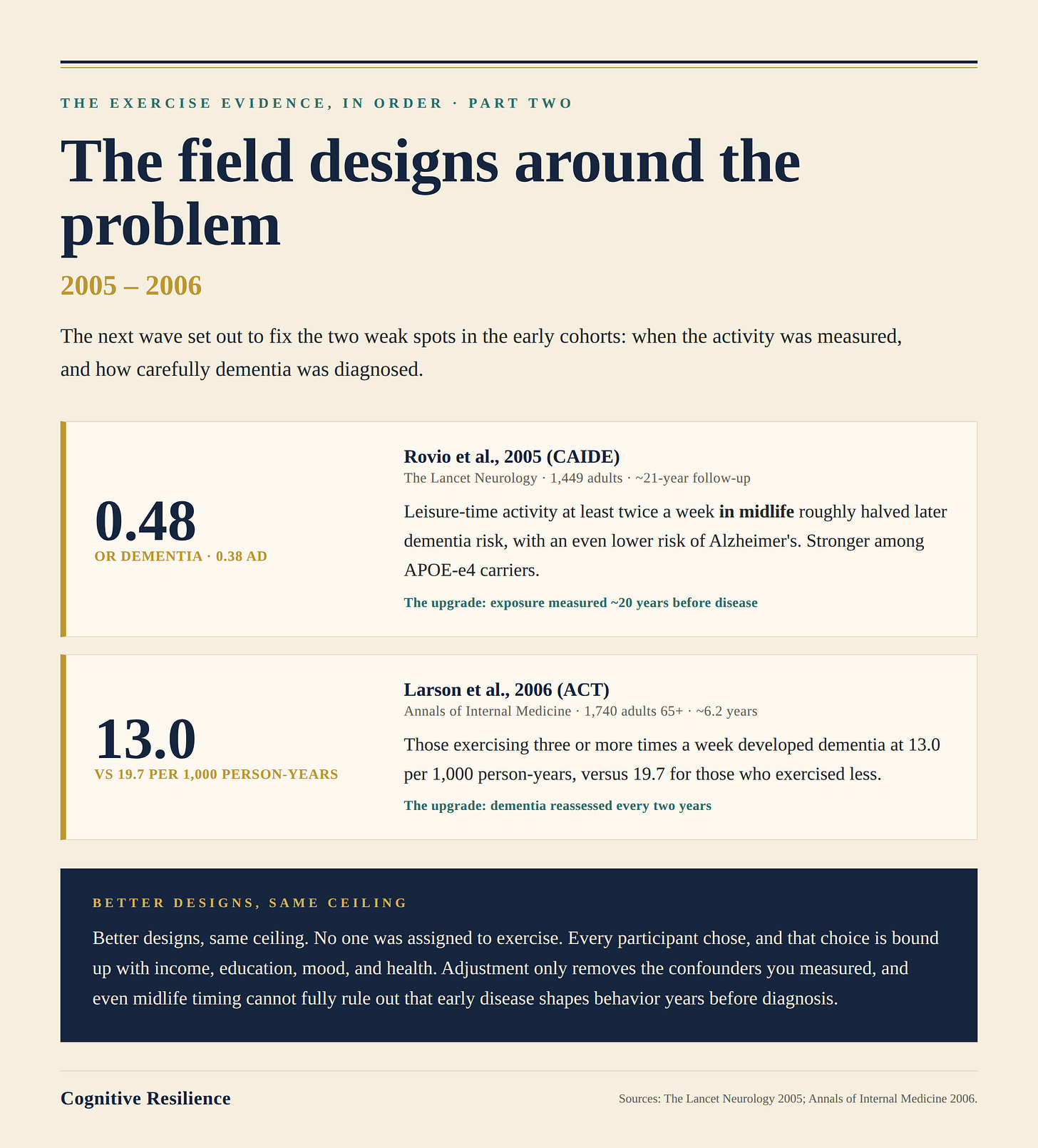
The first came from Finland and made the sharpest move available to an epidemiologist worried about reverse causation: measure the exercise decades earlier. The CAIDE study had surveyed people in midlife, then re-examined the survivors in old age. Of 1,449 people re-examined at ages 65 to 79, after an average of 21 years, those who had reported leisure-time physical activity at least twice a week in midlife had roughly half the risk of dementia and an even lower risk of Alzheimer’s disease, a finding published in The Lancet Neurology. The effect held after adjusting for education, vascular conditions, smoking, alcohol, and APOE genotype, and it was more pronounced among APOE-e4 carriers, the group at highest genetic risk.
The midlife timing matters. If activity is measured twenty years before any dementia appears, it is far harder to argue that early, undiagnosed disease quietly suppressed the activity. CAIDE did not eliminate that concern, but it pushed it back two decades, which is the strongest answer observational data had yet offered. It is also no coincidence that the senior author, Miia Kivipelto, went on to lead FINGER, the first major lifestyle-intervention trial. The midlife-prevention idea this series will reach later starts here.
The second study, from Seattle, attacked a different weakness: the quality of the outcome measurement. The Adult Changes in Thought cohort followed 1,740 cognitively normal adults over 65 for an average of 6.2 years, assessing them for dementia every two years rather than relying on records or recall. As reported in the Annals of Internal Medicine, those who exercised three or more times a week developed dementia at a rate of 13.0 per thousand person-years, against 19.7 for those who exercised less. At the time it was described as the most rigorous exercise-and-dementia study yet conducted, and it carried a memorable line from its lead author: use it even after you start to lose it, since the more frail participants seemed to benefit most.
So by 2006 the picture looked strong and was getting stronger. The association survived in a cohort with careful, repeated outcome assessment. It survived when exposure was measured in midlife, decades before disease. It survived adjustment for the obvious confounders. Each design choice answered one of the criticisms of the early work.
But notice what none of these studies could do, including the better ones. They could not assign people to exercise. Every participant chose how active to be, and that choice is tangled up with everything else about a person: income, education, mood, social life, baseline health. Statistical adjustment removes the confounders you measured and thought to include. It cannot remove the ones you did not. And even CAIDE’s midlife design, strong as it is, cannot fully rule out that the earliest biological changes of dementia influence behavior in midlife too.
The honest position after the second wave is that the observational case is now about as good as observational evidence gets: consistent, long-term, dose-responsive, robust to adjustment, and strongest in the highest-risk group. It is still not proof of cause. To get closer, the field needed to stop observing people’s choices and start assigning them, and to look directly at the brain. That shift, and the single most famous result it produced, is Part 3.
References
- Rovio S, Kåreholt I, Helkala EL, et al. Leisure-time physical activity at midlife and the risk of dementia and Alzheimer’s disease. The Lancet Neurology. 2005;4(11):705-711.
- Larson EB, Wang L, Bowen JD, et al. Exercise is associated with reduced risk for incident dementia among persons 65 years of age and older. Annals of Internal Medicine. 2006;144(2):73-81.