
The Exercise Evidence, Part 1: The Early Case That Activity Protects the Brain
The five-pillar framework begins with physical activity. This series works through the evidence in the order it arrived, starting at the turn of the millennium with the early cohort studies that made the case that active people get less dementia, and why that link was never proof of cause.
In the foundational post I set out the five-pillar framework and said I would work through the evidence behind each pillar before drawing conclusions. This series does that for the first pillar, physical activity, in the order the research actually arrived. The enthusiasm and the corrections, in sequence.
It starts at the turn of the millennium with one observation: people who moved more seemed to develop less dementia.
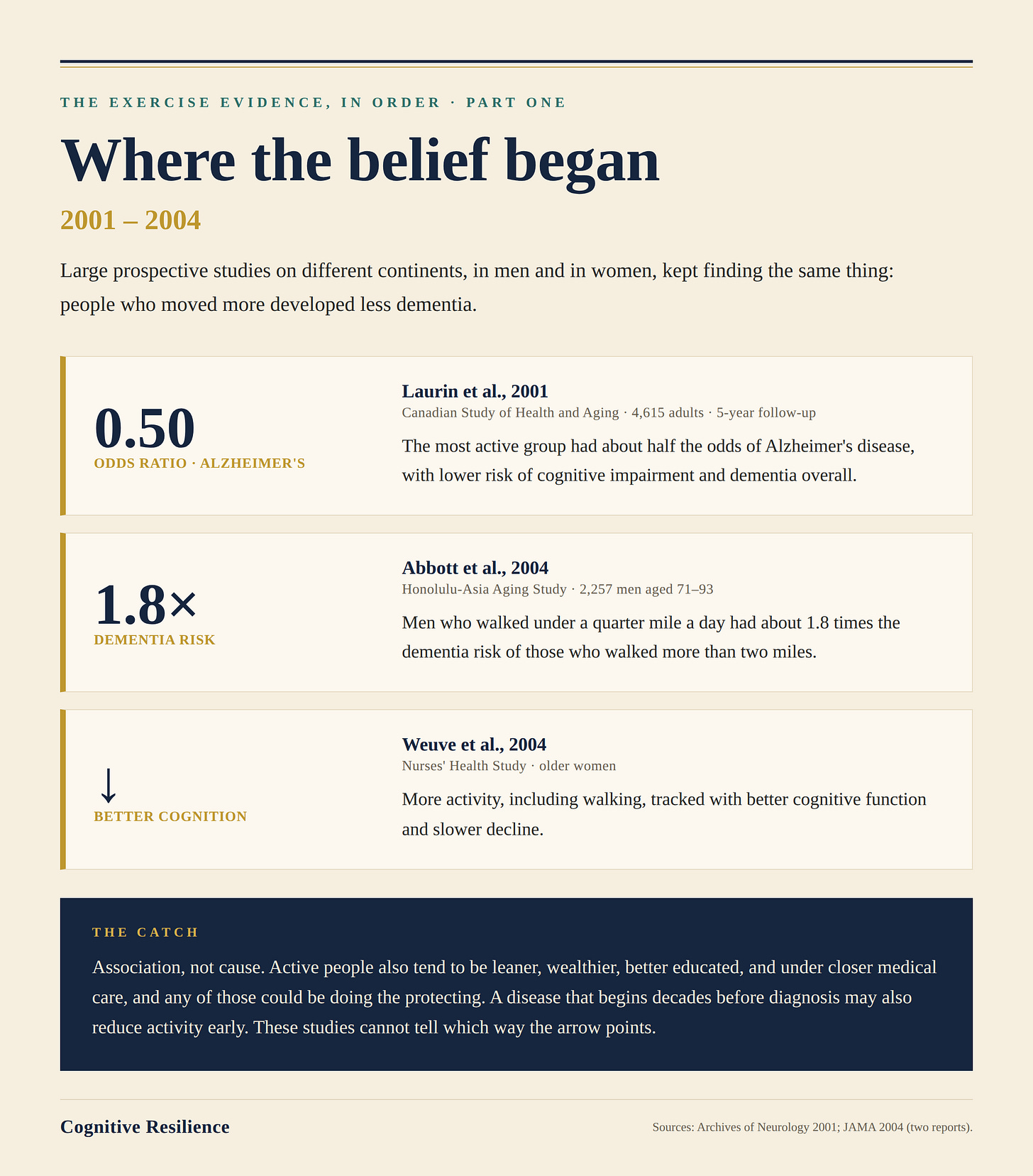
The early landmark came from Canada. A community study of more than nine thousand older adults, of whom 4,615 were cognitively normal at the start and completed five years of follow-up, reported in 2001 that high physical activity was associated with a reduced risk of cognitive impairment, Alzheimer’s disease, and dementia of any kind. The effect was not subtle. People in the most active group had roughly half the odds of developing Alzheimer’s disease, a result the authors laid out in the Archives of Neurology. For a field that had largely ignored modifiable lifestyle factors, that was an opening.
Three years later, a study made the idea concrete. Researchers asked whether something as ordinary as walking mattered, measuring daily walking distance in more than two thousand older men in Hawaii, part of a long-running cardiovascular cohort of Japanese-American men. As reported in JAMA, the men who walked least, under a quarter mile a day, had about 1.8 times the dementia risk of those who walked more than two miles a day. The same year, the Nurses’ Health Study reported the parallel result in older women: more activity, including walking, tracked with better cognition. The most accessible form of exercise there is, linked to a protected brain.
This is how the belief took hold, and the reasons it spread are good ones. Different countries, both sexes, different ways of measuring activity, all pointing the same direction. The studies were large, and they were prospective, meaning activity was recorded years before anyone developed dementia. The message that reached clinics and headlines was simple: move more, protect your mind.
The researchers themselves were more careful than the headlines. Abbott, the author of the walking study, noted that walking habits reflect a lifetime of behavior, and that people who stay active also tend to be leaner, less diabetic, better fed, and under closer medical care. Any of those could be doing the protecting. He went further and raised the possibility that people who walk less may already be developing the conditions that lead to dementia. That last idea is the crack in the foundation, and it widens later in this series.
What this evidence establishes is a real, consistent, biologically plausible link between physical activity and lower dementia risk. What it cannot establish is cause. An observational study shows that two things travel together. It cannot show that one produces the other. Two explanations fit these data equally well. Exercise protects the brain. Or exercise is a marker of an advantaged, healthy life, and an early casualty of a disease that begins long before it is diagnosed. In 2004, nobody could separate the two.
Separating them required a different tool: studies that assign people to exercise and watch the brain itself change. That arrived next, and it produced the single most cited exercise-and-brain finding ever published. That is Part 2.
References
- Laurin D, Verreault R, Lindsay J, MacPherson K, Rockwood K. Physical activity and risk of cognitive impairment and dementia in elderly persons. Archives of Neurology. 2001;58(3):498-504.
- Abbott RD, White LR, Ross GW, Masaki KH, Curb JD, Petrovitch H. Walking and dementia in physically capable elderly men. JAMA. 2004;292(12):1447-1453.
- Weuve J, Kang JH, Manson JE, Breteler MMB, Ware JH, Grodstein F. Physical activity, including walking, and cognitive function in older women. JAMA. 2004;292(12):1454-1461.