
The Exercise Evidence: What Should You Actually Do for Your Brain?
After nine posts taking the evidence apart, here is what survives, and what it means for how you live. Not the headline promise that exercise prevents dementia, but a smaller, sturdier conclusion about what movement can and cannot do for the aging brain, and how to act on it honestly.
We have spent this series being hard on a comforting idea.
Exercise prevents dementia, the headlines say. And across these posts, the evidence kept refusing to confirm it. The observational studies looked powerful, then turned out to be largely measuring the disease in reverse. The genetic tests found nothing. The single-exercise trials came back mostly empty. The multidomain trials turned modestly positive, but moved test scores without touching the disease in the brain.
If you read all of it, you would be forgiven for concluding that exercise does nothing for the mind, and giving up.
That would be the wrong lesson. So this last post does the opposite of the others. Instead of taking a claim apart, it puts the pieces back together, and asks the only question that finally matters: knowing all this, what should a person actually do?
What did not survive
Be clear about what we are giving up, because it matters.
The strong promise is gone. No randomized trial has shown that exercise, of any kind, at any dose, prevents dementia or lowers its rate. The famous statistic that active people get far less dementia turned out to be mostly reverse causation: the earliest, silent disease quietly slows people down years before diagnosis, which made exercise look more protective than it is.
And the studies built specifically to catch that effect confirmed it. When activity was measured ten or more years before diagnosis, far enough back to clear the silent phase, the protective link largely vanished. The strongest long-term cohort, following people for nearly thirty years from midlife, found no association at all once it accounted for the decline that precedes dementia.
The most rigorous long-term test makes the same point. A pooled analysis of two prevention trials, followed for up to twelve years, found no reduction in dementia in any group it looked at, not by age, not by genetics, not by risk level.
So when someone tells you the science proves exercise wards off Alzheimer's, they are reaching past the evidence. That promise did not hold.
What did survive, in order of confidence
Now the other half, the half the deflation can hide. Several real things came through intact. It helps to rank them honestly, from the best-supported to the least certain.
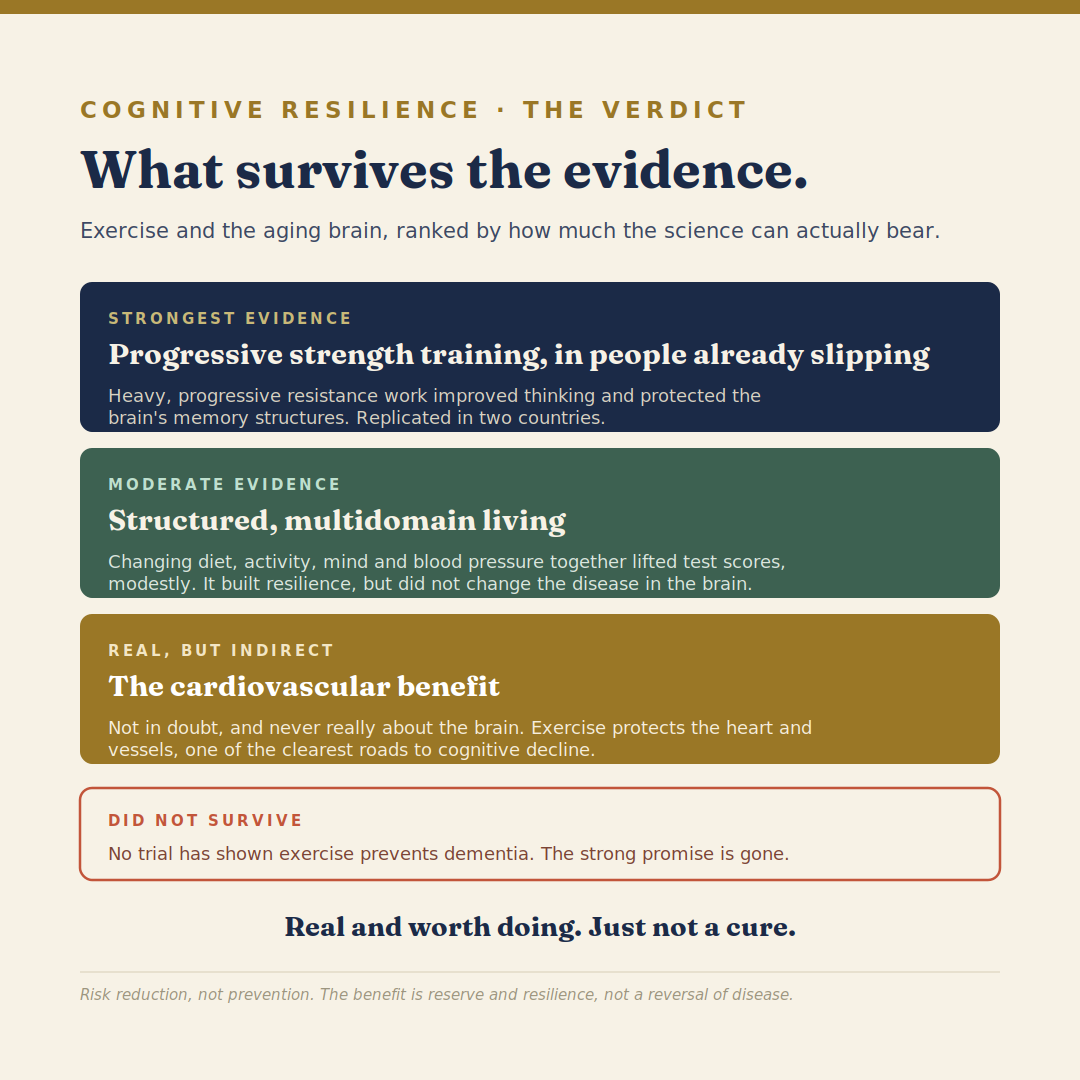
Strongest: progressive strength training in people already slipping. This is the firmest finding in the whole series. In people with mild cognitive impairment, heavy, progressive resistance training improved thinking, and it did something no other single approach managed: it protected the specific memory structures of the brain, and that physical preservation was what carried the cognitive gain. Two independent labs, on two continents, pointed the same way. It is the one place where thinking, brain structure, and a believable mechanism all moved together in a randomized trial.
Moderate: structured, multidomain living. When trials changed several things at once, diet, activity, mind, and blood pressure, cognitive scores improved, modestly, and the result replicated from Finland to the United States. The improvement was real and rated high-certainty. But it did not reduce dementia, and when the newest trial scanned people's brains, the program had changed none of the disease markers. The benefit looks like resilience, a brain coping better with its burden, rather than a reversal of disease.
Real but indirect: the vascular benefit. This one is not in doubt at all, it simply was never really about the brain. Exercise lowers blood pressure, diabetes, heart disease, and stroke, and that vascular damage is one of the clearest contributors to cognitive decline. This is among the best-established findings in medicine, and it is not haunted by reverse causation. Protect the blood vessels, and you protect one of the main roads to a failing brain.
None of these is a cure. All of them are real. That is a very different conclusion from "exercise does nothing."
The honest way to think about it
Here is the frame that fits the evidence.
Exercise is not a drug that clears the disease. It is a way of building reserve, a brain and a vascular system more able to withstand what age and pathology throw at them. It buys resilience, not immunity.
That means the right expectation is risk reduction, not prevention. You are improving your odds and your function, not guaranteeing an outcome. And the thing measured in most of these studies, a better cognitive test score, is a hopeful sign, not proof that dementia itself was held off.
Hold those two thoughts together and you have the honest position: real, worthwhile, bounded. Worth doing precisely because the benefits that survived are the ones that touch the rest of your health too.
What actually separated the wins from the misses
One pattern ran underneath the whole series, and it is the most useful thing in it.
The line between what worked and what did not was not aerobic versus strength, or one change versus many. It was intensity, progression, structure, and sustained engagement.
The strength trials that worked used heavy, progressive load. The walking program that used ankle weights did not. The multidomain trial that worked was demanding and supervised over two years. The one that failed had most participants drifting away from it. The big intensity trial found nothing, partly because its comparison group quietly exercised about as much as the trained groups.
The implication is that the dose matters more than the label. A gentle stroll and a hard, progressive program are not the same intervention, and the evidence stops making sense if you treat them as interchangeable. What the brain seems to respond to is effort, structure, and years, not a category on a form.
So, concretely, what to do
If you want the practical version, the evidence supports a short, unglamorous list.
Move most days, at a moderate level you can sustain. The first walk off the couch matters more than the last hard mile, and the cardiovascular benefit alone justifies it.
Add strength training two or three times a week, and let the load climb as you get stronger. That progression appears to be the active part, and it has the strongest single-intervention evidence behind it.
Treat the standard guideline as the target: about 150 minutes a week of moderate activity, plus those strength sessions. Not because a trial proved it saves memory, but because it reliably protects the heart and vessels the brain depends on.
Do not just exercise. The trials that worked changed several things at once. Pair the activity with a reasonable diet, blood-pressure and metabolic care, mental engagement, and sleep. The pattern, not the single lever, is what moved the needle.
Start sooner if you can. Activity in midlife carried the clearest benefit, and intensity seemed to matter more then. In later life it matters far less, even light activity helps, so it is never too late to begin, and never wasted.
And keep going. The benefit lives in the years, not the weeks.
What remains unknown
The honest ending is that the biggest question is still open.
No trial has yet shown that exercise prevents dementia, and the trials that could answer it would need to run for decades, count actual diagnoses rather than test scores, and somehow separate the exercise from the diet, the mental engagement, and the company that usually come bundled with it. Until those exist, certainty is not on offer.
What we can say is narrower and, in its way, more trustworthy. Exercise almost certainly helps the aging brain. The benefit is real and modest. The strongest evidence points to progressive strength training in people already beginning to slip, rather than gentle walking in the general population. And the surest gains, for the heart and vessels, are the ones that carry the brain along the same road.
The last word. The promise that exercise prevents dementia did not survive honest scrutiny. What survived is quieter and more dependable: regular movement protects the systems through which much of cognitive decline travels, builds a measure of resilience, and improves your odds without pretending to guarantee them. That is not the headline. It is something better, a reason to act that does not rest on a promise the science cannot keep. So move, get stronger, tend the whole pattern of your health, and start before you feel you need to. Not because it makes you immune, but because it is one of the few things within your control that genuinely shifts the odds, and because almost everything that helps the rest of you appears to help the brain along the same road. The brain responds to a life lived with structure, effort, and sustained engagement, not to a headline.
This is general science writing about published research, not medical advice. Decisions about exercise and brain health, particularly for anyone with a memory concern or a medical condition, belong with your own clinician.
References
- Sabia S, Dugravot A, Dartigues JF, et al. Physical activity, cognitive decline, and risk of dementia: 28 year follow-up of Whitehall II cohort study. BMJ. 2017;357:j2709. https://doi.org/10.1136/bmj.j2709
- Baumeister SE, Karch A, Bahls M, et al. Physical activity and risk of Alzheimer disease: a 2-sample Mendelian randomization study. Neurology. 2020;95(13):e1897–e1905. https://doi.org/10.1212/WNL.0000000000010013
- Fiatarone Singh MA, Gates N, Saigal N, et al. The Study of Mental and Resistance Training (SMART) study: resistance training and/or cognitive training in mild cognitive impairment. J Am Med Dir Assoc. 2014;15(12):873–880. https://doi.org/10.1016/j.jamda.2014.09.010
- Broadhouse KM, Singh MF, Suo C, et al. Hippocampal plasticity underpins long-term cognitive gains from resistance exercise in MCI. Neuroimage Clin. 2020;25:102182. https://doi.org/10.1016/j.nicl.2020.102182
- Ngandu T, Lehtisalo J, Solomon A, et al. A 2 year multidomain intervention of diet, exercise, cognitive training, and vascular risk monitoring versus control to prevent cognitive decline in at-risk elderly people (FINGER): a randomised controlled trial. Lancet. 2015;385(9984):2255–2263. https://doi.org/10.1016/S0140-6736(15)60461-5
- Baker LD, Espeland MA, Whitmer RA, et al. Structured vs self-guided multidomain lifestyle interventions for global cognitive function: the US POINTER randomized clinical trial. JAMA. 2025;334(8):681–691. https://doi.org/10.1001/jama.2025.12923
- Hafdi M, Hoevenaar-Blom MP, Richard E. Multi-domain interventions for the prevention of dementia and cognitive decline. Cochrane Database Syst Rev. 2021;(11):CD013572. https://doi.org/10.1002/14651858.CD013572.pub2
- Coley N, Hoevenaar-Blom MP, Shourick J, et al. Searching for responders to multidomain dementia prevention in late life: a pooled analysis of individual participant data from the MAPT and preDIVA trials. Alzheimers Dement. 2025. https://doi.org/10.1002/alz.14458