
The Exercise Evidence, Part 7: Can Exercise Alone Protect the Brain?
The observational case was strong but confounded. So researchers ran the clean test: large randomized trials of exercise by itself, measured against real cognitive decline, before anyone added diet or mental training. The bigger and stricter the trial, the smaller the effect got.
Everyone knows exercise is good for the brain. Stay active, the advice goes, and you are less likely to lose your memory as you age. It is one of the most repeated promises in health.
The trouble is where that promise comes from. Most of the evidence behind it is observational, built by watching large groups of people over time and noticing that the active ones develop less dementia. And as the last two posts showed, watching has a built-in trap. The people who move less are often already in the earliest, silent stages of the disease, years before any diagnosis, and the disease itself is what slowed them down. Their inactivity is a symptom, not a cause. So the link looks like protection, when a good part of it runs the other way.
There is one way to cut through that. Take people who are not yet declining, randomly assign some to exercise and some not, and wait. Randomization breaks the trap, because the disease cannot choose who gets sent to the gym. If the exercisers end up better off, it is the exercise, not some hidden head start they had all along.
If exercise protects the aging brain, this is where it should show. Several large trials ran exactly that experiment. Their results are why the confident prevention message has quietly softened among researchers, even as it stayed loud everywhere else.
The big prevention trial
The largest was LIFE, published in 2015. It took sedentary older adults, most of them in their seventies and eighties, and assigned them either to a two-year exercise program or to a health-education program for comparison.
The exercise was a mix: walking, light strength work with ankle weights, balance, and stretching. The comparison group was not idle. They came to regular workshops with talks, discussion, and guest speakers, the kind of thing that keeps a mind engaged and a calendar social.
The exercisers did become more active. The question was whether their thinking held up any better.
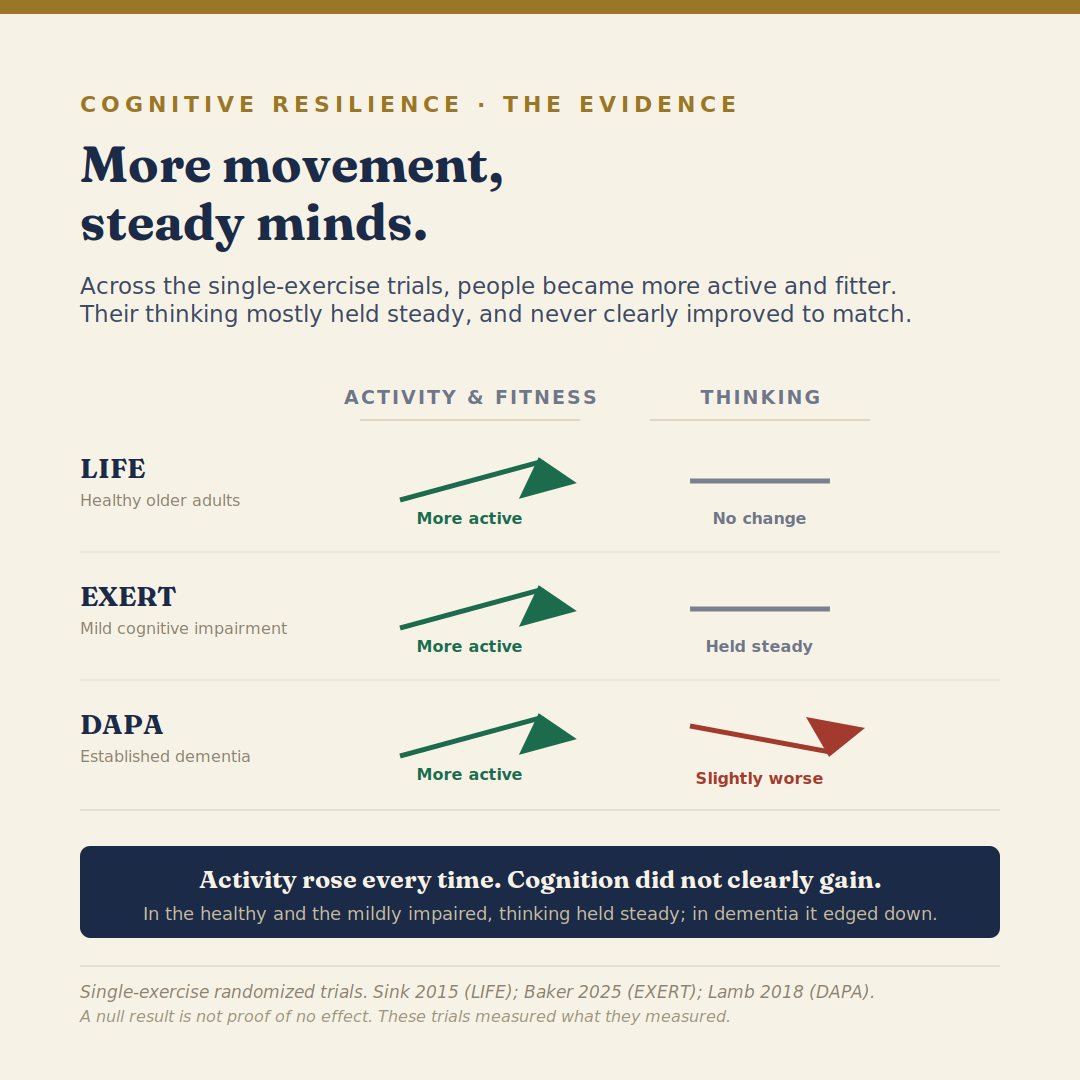
On the main cognitive tests, it did not. After two years, the exercise group scored no higher than the comparison group, on memory, on processing speed, on executive function. The exercise worked as exercise. Fitness rose. The clear cognitive edge the observational studies had promised did not appear.
But the result is gentler than a flat failure, and the researchers said so plainly. Nobody declined. Both groups held steady over the two years, and the authors wrote that they could not rule out that both programs had helped preserve cognition. The exercise may not have beaten the comparison because the comparison, with its mental and social engagement, was doing some good of its own.
Two other things temper the null. These were highly educated people, two-thirds had been to college, and that mental reserve may have protected everyone over a span as short as two years. And cognition was not even the trial’s main target; LIFE was built to study physical mobility, with the thinking tests added on, and was never designed to settle the dementia question on its own.
There was also one signal worth holding. Among the oldest participants and those who started out most physically frail, the exercisers did do better on executive function than the comparison group. The authors took it seriously enough to suggest that for the most vulnerable, exercise might still matter.
So LIFE is not a clean verdict that exercise does nothing. It is a careful trial where structured exercise did not outperform an engaged, social comparison, where everyone held steady, and where the frailest still seemed to gain something.
It was not alone in coming up short on the main question. A review pooling a dozen aerobic-exercise trials in healthy older adults found the same pattern: fitness improved, and the cognitive scores did not clearly follow.
The trial in people already slipping
LIFE looked at healthy adults. A harder question is whether exercise helps people who have already begun to slip, the stage called mild cognitive impairment. A trial called EXERT set out to answer it, and its result is the most interesting of the bunch, because it is not clean.
EXERT compared two programs in people with mild cognitive impairment: harder aerobic training, and gentle stretching and balance work meant to be the placebo. Over a year, the aerobic group did no better than the stretching group. By the comparison it was designed to make, it found nothing.
But something odd showed up underneath. Neither group declined. People with mild cognitive impairment usually lose a measurable amount of ground over a year, and these participants, in both arms, held steady instead.
The researchers were careful about what that could mean, and they laid out both sides. One reading is that any structured, supported activity, even gentle stretching, together with the social contact built into the program, may have helped hold the line. The other is more deflating: the people who joined and stuck with a long, demanding exercise study may simply have been healthier and more resilient to begin with, the kind who would have held steady anyway.
The trial cannot tell these apart, because it had no true do-nothing group inside it. The steady scores could be the movement, the company, or the kind of person who signs up.
So EXERT neither rescues the simple claim nor buries it. It hints, without proving, that structure and contact may matter as much as the exercise itself, a thread worth keeping hold of.
The result that unsettled people
If LIFE was a letdown, the DAPA trial was the one that genuinely bothered the field.
It asked a different question. Not whether exercise prevents decline in healthy people, but whether it slows decline in people who already have dementia. Just under 500 of them were assigned, two to one, to a supervised program of moderate-to-high intensity exercise, or to usual care.
Again, the exercise worked as exercise. People stuck with it, and their fitness improved.
Their thinking did not. A year in, the exercise group had done slightly worse than the usual-care group, not better.
The difference was small, and the researchers were careful: this is not proof that exercise harmed anyone. But it was real enough that they said something striking. They could not recommend this kind of program to slow decline in dementia. And future trials, they wrote, should at least consider that some exercise might make things worse.
That is a long way from exercise prevents dementia.
Why this does not contradict Part 5
A careful reader will push back. Part 5 described trials where strength training did help. How does that sit with these?
It sits fine, because they tested different things in different people. The strength-training trials that worked used heavy, progressive resistance, pushed hard and increased over time, in people with mild cognitive impairment. The big null trials used lighter, gentler activity, and LIFE’s strength component was exactly that, a few minutes with ankle weights, in older adults who were frail enough to be at risk of losing their mobility. Same broad category, very different doses and very different people.
So the honest summary is not that exercise does nothing for the brain. It is narrower. Gentle activity prescribed to prevent decline in the general population has not clearly outperformed its comparisons in the trials built to test it. Heavy, progressive strength training in people beginning to slip has shown a real but modest signal. And exercise given to people who already have dementia has not been shown to slow it.
The trial that did find something
Not every trial came up empty, and honesty means saying so. One of the earliest, a 2008 study in older adults with memory complaints, gave people a six-month home-based activity program and found a real, modest benefit on cognition by the end of it, while the comparison group slipped.
It is the cleanest positive single-domain result in this literature. But two things keep it in proportion. The benefit was small. And it was clearest right when the program ended; by the eighteen-month mark the two groups had largely converged, the advantage fading as the structured activity stopped. A genuine signal, then, but a modest and short-lived one, which is a fair description of the best case the trials offer.
There is an obvious reply to all of this. Maybe exercise was never meant to work alone, and only protects the brain as part of a fuller program. That possibility is real, and it is the one piece of the puzzle these single-factor trials cannot speak to.
What a failed trial does, and does not, prove
One piece of honesty, because it cuts against the easy conclusion.
A trial that finds nothing has not proven there is nothing to find. It has shown that this approach, at this dose, for this long, in these people, did not produce a benefit anyone could measure. A different dose, a longer stretch, a different group, or a different kind of exercise could still show something.
LIFE ran two years. That is long for a trial and short for dementia, which builds over decades. The prevention question, asked on a timescale a trial can actually afford, may be one no single trial can answer.
So the trials do not slam the door. What they do is take away the strongest reason to believe the prevention claim. The observational case turned out to be largely reverse causation. The genetic test found nothing. And the most direct experiments came back empty.
The take-home. When researchers ran the clean experiment, assigning people to exercise and measuring their thinking, the clear benefit did not appear. In the largest prevention trial, exercise did not outperform an engaged, social comparison group over two years, and a review of the smaller trials found the same. In mild cognitive impairment, harder exercise did no better than gentle stretching, and both groups held steady when decline was expected, which may say more about structure and company than about the exercise. In people who already had dementia, exercise improved fitness but not thinking, and possibly nudged it the wrong way. One early trial did find a modest benefit, though it faded once the program ended. None of this makes exercise useless for the brain, and it does not touch the heart and blood-vessel benefits, which are real, or the strength-training signal in mild cognitive impairment. It means the most direct test of the prevention claim did not confirm it.
And yet the trials so far share a feature. Each one changed a single part of life, the exercise, and held everything else constant. There is another kind of trial, one that combined exercise with diet, mental engagement, and blood-pressure care into one sustained program. That is the one place the randomized evidence turned positive. That is Part 8.
This is general science writing about published research, not medical advice. Decisions about exercise, particularly for anyone with a memory concern or a medical condition, belong with your own clinician.
References
- Sink KM, Espeland MA, Castro CM, et al. Effect of a 24-month physical activity intervention vs health education on cognitive outcomes in sedentary older adults: the LIFE randomized trial. JAMA. 2015;314(8):781–790. https://doi.org/10.1001/jama.2015.9617
- Young J, Angevaren M, Rusted J, Tabet N. Aerobic exercise to improve cognitive function in older people without known cognitive impairment. Cochrane Database Syst Rev. 2015;(4):CD005381. https://doi.org/10.1002/14651858.CD005381.pub4
- Baker LD, Cotman CW, Thomas R, et al. Effects of exercise on cognition and Alzheimer’s biomarkers in a randomized controlled trial of adults with mild cognitive impairment: the EXERT study. Alzheimers Dement. 2025;21(4):e14586. https://doi.org/10.1002/alz.14586
- Lautenschlager NT, Cox KL, Flicker L, et al. Effect of physical activity on cognitive function in older adults at risk for Alzheimer disease: a randomized trial. JAMA. 2008;300(9):1027–1037. https://doi.org/10.1001/jama.300.9.1027
- Lamb SE, Sheehan B, Atherton N, et al; DAPA Trial Investigators. Dementia And Physical Activity (DAPA) trial of moderate to high intensity exercise training for people with dementia: randomised controlled trial. BMJ. 2018;361:k1675. https://doi.org/10.1136/bmj.k1675