
The Exercise Evidence, Part 8: Do Combined Lifestyle Changes Protect the Brain?
Exercise alone kept coming up short in the trials. So researchers stopped testing it in isolation and changed diet, activity, mental engagement, and blood pressure together. That is where the first genuinely positive prevention trials appeared, and where the picture finally starts to turn.
The last post ended on a hard note.
Exercise tested on its own, trial after trial, did not clearly protect thinking. The walking trials missed. The trial in people with dementia edged the wrong way. The one positive result faded once the program stopped.
But all those trials shared a design. Each one changed a single thing, the exercise, and held the rest of life steady.
And a different possibility had been sitting underneath the whole time. Maybe the brain does not respond much to one lever pulled on its own. Maybe it responds to a whole life lived differently.
That is what the next trials set out to test. Instead of prescribing exercise alone, they changed several things at once: diet, activity, mental challenge, social contact, and blood pressure, all together, as one program.
This is the part of the story where the evidence finally turns positive. After all the nulls, that matters. The turn is real, and it is worth understanding exactly, both what it reaches and what it does not.
The Finnish trial that started it
The landmark was a Finnish study called FINGER, published in 2015.
It took more than 1,200 older adults who were at higher risk of decline, and split them into two groups.
One group got a structured, two-year program: a brain-healthy diet, regular exercise including strength work, cognitive training, and close monitoring of blood pressure and other vascular risks. The other group got general health advice.
After two years, the structured group came out ahead on a battery of thinking tests, and the difference was statistically clear. This was the first time a prevention trial had shown it: change enough of a person’s life at once, for long enough, and cognition responds. The single-factor trials had never managed it.
The effect was modest. Both groups improved, and the structured group improved a bit more, a difference real enough to measure and small enough that the headlines describing it tended to sound larger than the result.
That does not diminish what FINGER did. It established the principle. The work since has been about how far the principle reaches.
The American trial that tested whether it travels
A result in 1,200 Finns is a starting point, not a conclusion. The real question was whether it would hold somewhere else: a bigger group, a more varied population, ordinary American communities.
So the trial was rebuilt in the United States, much larger, and the results came out in 2025.
The U.S. version was called POINTER. It enrolled more than 2,000 older adults at risk of decline, nearly a third of them from minority communities.
But it was built with one telling difference.
Instead of comparing a lifestyle program against plain health advice, it compared two versions of the lifestyle program. One was structured, with a coach, a team, and regular accountability. The other was self-guided: people got the same recommendations, but mostly carried them out on their own.
Both groups improved over two years. The structured group improved a little more, and the difference held up statistically.
Two things are true in that result, and both matter.
Structure and accountability added a real but small edge over going it alone. And everyone improved, the coached and the self-guided alike, once they took up the lifestyle changes.
POINTER is being celebrated as proof that lifestyle protects the brain. That it reproduced FINGER’s signal, in a much larger and far more diverse group, on a different continent, is a genuine result. Lifestyle change of this kind appears to help, and it helps across the range of people who took it up.
What the trial could not show is also worth being clear about. There was no group that did nothing.
With both arms following the program, the trial cannot fully separate the lifestyle’s effect from practice on the tests, the attention of being studied, or the kind of person who enrolls and stays two years.
It shows that structure beats self-direction. It leaves open how much either beats doing nothing at all. That is a real limit, and it does not erase the gain.
What the brain scans showed, and did not
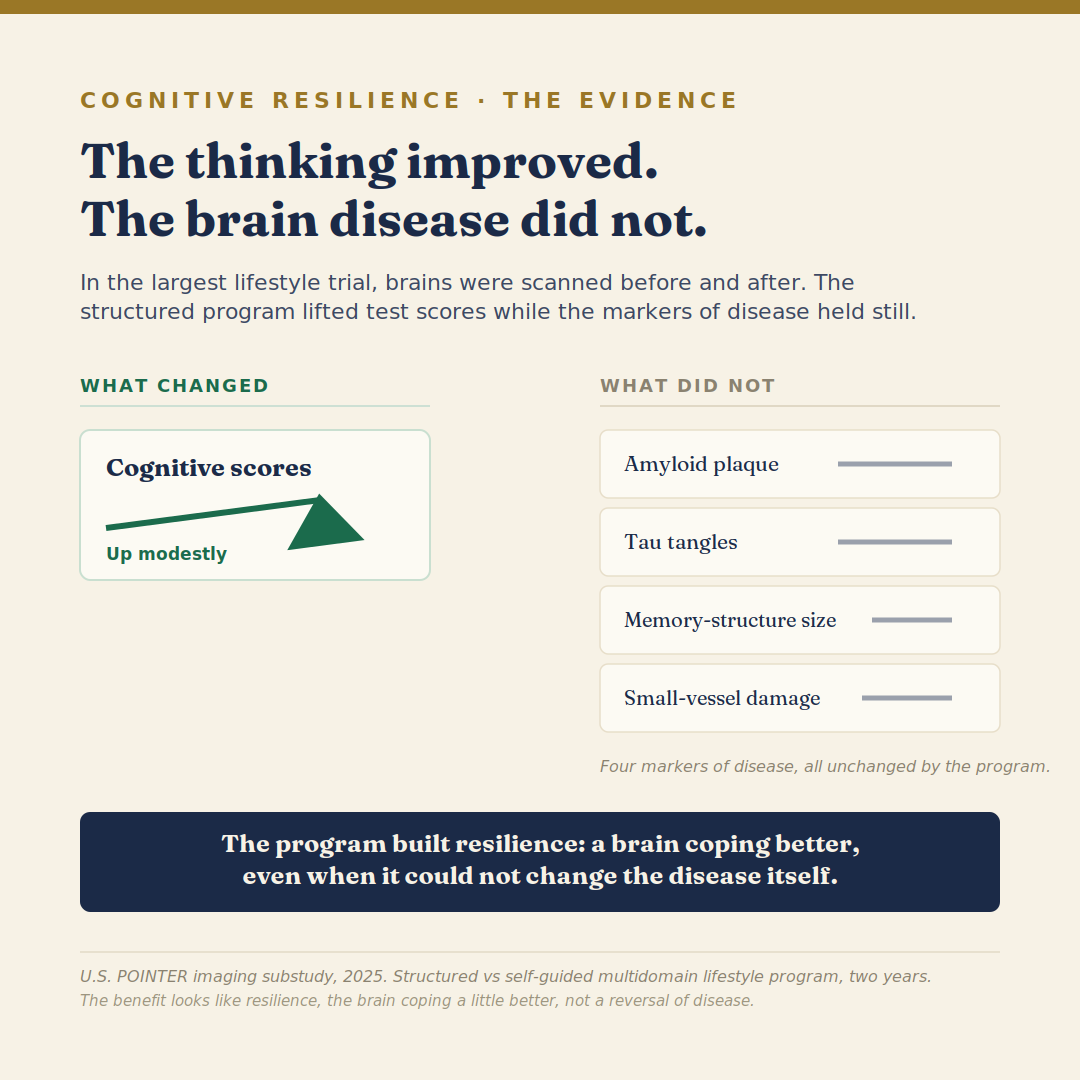
POINTER did something most prevention trials never manage. Alongside the main study, a companion imaging study scanned participants’ brains.
About half of them had scans at the start and again at the end. The scans looked for the markers of Alzheimer’s disease: amyloid, tau, the size of the brain’s memory structures, and the small-vessel damage that shows up as white spots.
If the lifestyle program were actually slowing the disease, this is where it would show.
It did not.
Over the two years, the structured program changed none of those four markers compared to the self-guided one. The thinking scores moved. The disease in the brain did not.
That is worth sitting with, because it tells you what kind of benefit this is.
Whatever the program did for people’s test scores, it did not do it by clearing amyloid, slowing tau, or rebuilding the memory structures. The benefit looks like resilience, the brain coping a little better with the burden it already carries, rather than a reversal of the disease.
There was also a genuinely encouraging signal in the scans.
Among people who started with the worrying brain findings, smaller memory structures or more tau, the ones in the structured program did better on thinking than their counterparts who were self-guided.
So the structure seemed to help most exactly the people whose brains were already under strain, the ones with the most to lose. That is a meaningful finding. It is a cognitive benefit rather than a change in the underlying disease, but for a person at risk, a mind that works better is the thing that matters.
The trial that did not work
If the lesson were simply that bundling works, it would be too tidy. And this evidence has rarely been tidy.
So here is the trial that complicates it.
A French study called MAPT ran the same basic idea, exercise plus nutrition plus cognitive training, over three years. On its main measure, it found essentially nothing.
A faint signal showed up in the people at highest risk, but the authors would not lean on it, and the trial as a whole came back empty.
So a multidomain program is not automatically a winning one. One large, serious version succeeded modestly. Another in the same spirit did not. The biggest of them showed mainly that more structure beats less.
Combining things, by itself, is not the active ingredient.
When everything is pooled together
Step back from any single trial and look at all of them at once. That is what a careful review, published through Cochrane, did.
Pulling the multidomain trials together, it found two things that belong side by side.
The honest good news: across the trials, the programs produced a small but real improvement on cognitive tests. The reviewers rated that finding high-certainty.
The harder news: across the trials that tracked who actually developed dementia, the programs did not reduce it. The rate of dementia in the people doing the programs was no different from the rate in those who were not.
And the reviewers raised one more caution, the same one POINTER could not escape.
The cognitive benefit was strongest in exactly the trials that included brain-training exercises. That leaves an awkward possibility open: some of what looks like clearer thinking may be people getting better at taking the tests, rather than a brain better protected from disease.
The two are genuinely hard to tell apart.
What separates the wins from the misses
This is the thread that has been running quietly under the whole series. Here is where it surfaces.
Set the trials side by side, and the line between what worked and what did not is not aerobic versus strength, or one factor versus many.
It is structure, intensity, and sustained engagement.
FINGER worked, and it was demanding: supervised, progressive, two years long, with real accountability built in. POINTER’s structured arm beat its self-guided arm on exactly that axis, more support, more accountability, more intensity.
The trials that enrolled people at real risk and pushed them hard tended to move the needle. The ones that enrolled broad populations and asked little of them tended not to.
The strength-training trials from Part 5 fit the same pattern. The most progressive and demanding of them were the ones that showed something.
So the pattern is not “do this one exercise.”
It is closer to “build a structured, engaged, sustained way of living, and keep at it for years.”
That is a harder thing to package, and a harder thing to follow, than a pill or a daily step count. It may also be why it works, and why it so rarely survives the trip from trial to headline.
The take-home. When trials stopped testing exercise in isolation and changed the whole pattern of life instead, the evidence turned positive. FINGER showed it first, POINTER confirmed it in a large and diverse population, and the gains were real, modest, and most pronounced in the people at highest risk. That is genuinely good news, and it is more than the single-factor trials ever delivered. The honest boundaries matter too. Pooled together, these programs improved cognitive test scores without yet reducing dementia itself, and when the newest trial scanned people's brains, the structure changed how they scored without changing the disease in their heads. So the benefit looks like resilience, a brain coping better with its burden, rather than a cure for what causes the burden. What seems to drive it is not any single activity but structure, intensity, and the will to keep going. It asks a great deal, and it gives something real in return. For anyone trying to protect their mind, that is a finding worth acting on, not a disappointment.
That leaves the question everyone actually wants answered. If structure and consistency matter more than the specific exercise, then how much, and what kind, should a person do? That is the next post.
This is general science writing about published research, not medical advice. Decisions about exercise, diet, or any health program, particularly for anyone with a memory concern or a medical condition, belong with your own clinician.
References
- Ngandu T, Lehtisalo J, Solomon A, et al. A 2 year multidomain intervention of diet, exercise, cognitive training, and vascular risk monitoring versus control to prevent cognitive decline in at-risk elderly people (FINGER): a randomised controlled trial. Lancet. 2015;385(9984):2255–2263. https://doi.org/10.1016/S0140-6736(15)60461-5
- Baker LD, Espeland MA, Whitmer RA, et al. Structured vs self-guided multidomain lifestyle interventions for global cognitive function: the US POINTER randomized clinical trial. JAMA. 2025;334(8):681–691. https://doi.org/10.1001/jama.2025.12923
- Landau SM, Baker LD, Whitmer RA, et al. Brain imaging biomarkers and cognitive outcomes in a multidomain lifestyle intervention: the POINTER imaging ancillary study. JAMA Neurology. 2025. Published online. https://pubmed.ncbi.nlm.nih.gov/42008251/
- Andrieu S, Guyonnet S, Coley N, et al; MAPT Study Group. Effect of long-term omega 3 polyunsaturated fatty acid supplementation with or without multidomain intervention on cognitive function in elderly adults with memory complaints (MAPT): a randomised, placebo-controlled trial. Lancet Neurol. 2017;16(5):377–389. https://doi.org/10.1016/S1474-4422(17)30040-6
- Hafdi M, Hoevenaar-Blom MP, Richard E. Multi-domain interventions for the prevention of dementia and cognitive decline. Cochrane Database Syst Rev. 2021;(11):CD013572. https://doi.org/10.1002/14651858.CD013572.pub2