
The Exercise Evidence, Part 6: Does Exercise Protect the Brain, or Predict It?
Every study so far shared one weakness: people chose whether to exercise. So does activity protect the brain, or do the people destined to stay sharp simply stay active longer? Two studies were built to tell the difference, and their answer is sobering.
Across the first five parts of this series, one fact never wavered. Active people get less dementia, and the association is large and has been measured many times. Part 5 added the strongest piece yet, a controlled trial where resistance training preserved both cognition and the brain structures that decline first. But the broad claim that exercise prevents dementia in the general population rests mostly on observation, and observation carries a problem that no number of consistent cohorts can fix on its own.
The problem is direction. When inactive people develop more dementia, two stories fit the data equally well. In the first, inactivity is a cause, and moving more would lower the risk. In the second, the earliest stages of the disease, which begin years before any diagnosis, gradually make people less active, so the inactivity is an early symptom rather than a cause. The cohorts that opened this series cannot separate these, because both produce the same correlation. This post is about two research designs built to tell them apart, and about how the answer they return complicates the simple prevention story.
The long watch
The first approach is to follow people long enough to see whether activity was already falling before the disease surfaced. If inactivity causes dementia, the people who go on to develop it should be less active for decades beforehand. If the disease drives the inactivity instead, their activity should look normal far in advance and then fall only in the years just before diagnosis.
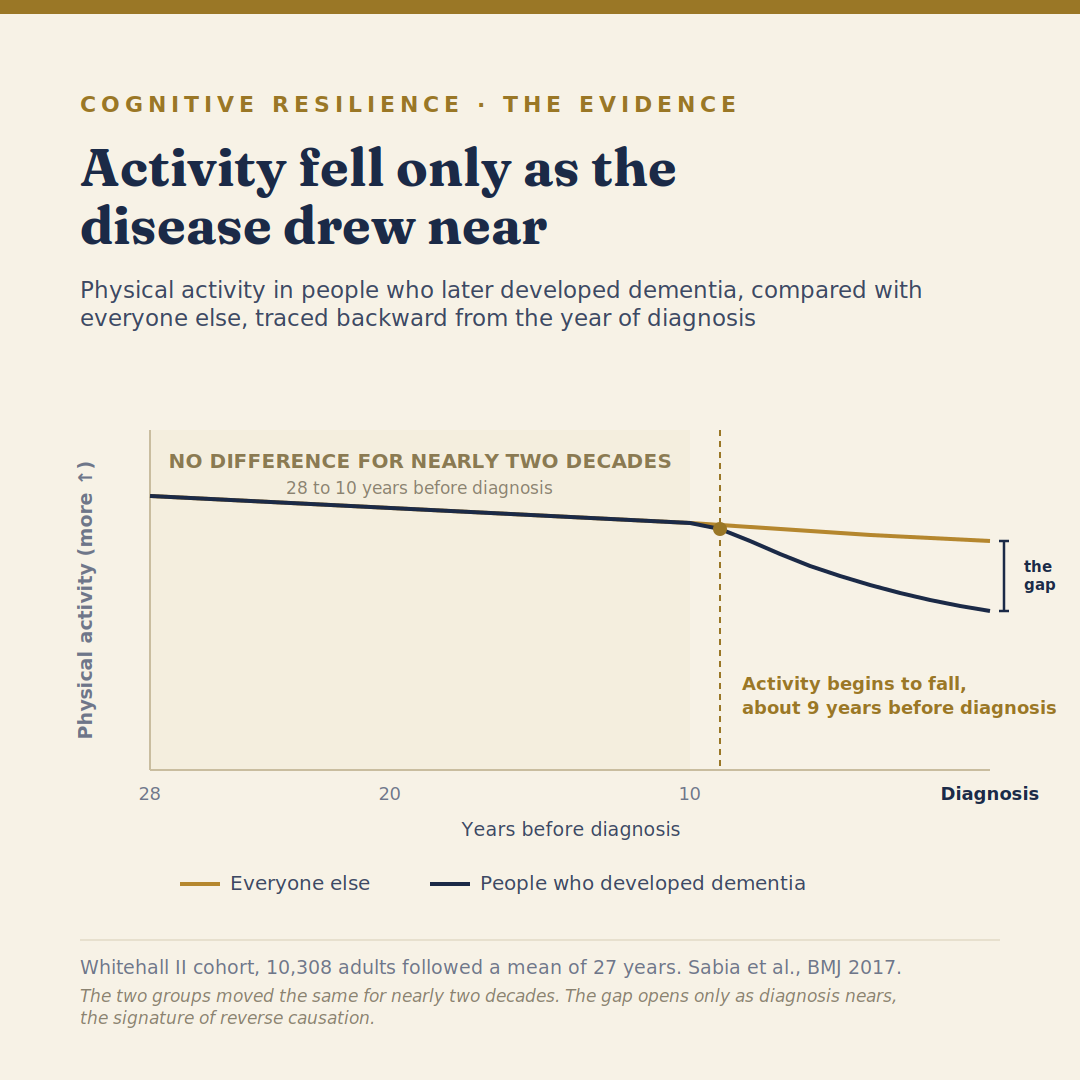
The Whitehall II study followed just over 10,000 British civil servants for a mean of 27 years, measuring physical activity seven times along the way. The result was the second pattern, and it was clean. Midlife activity was not associated with dementia risk; people meeting the recommended activity level had a hazard ratio of 1.00. And when the researchers traced activity backward from the year of diagnosis, they found no difference between those who developed dementia and those who did not, from 28 years before diagnosis down to about 10 years before. Then, starting roughly nine years out, the future-dementia group’s activity began to fall, and the gap widened as diagnosis approached.
That shape is the signature of reverse causation. For two decades the future patients moved as much as everyone else. Their activity dropped only once the disease was near, which is what you would expect if the early, undiagnosed disease was the thing reducing how much they moved. The authors stated it plainly: the study found no evidence of a neuroprotective effect, and the lower dementia rates seen among active people in shorter studies are most likely explained by activity falling in the preclinical phase.
The genetic experiment
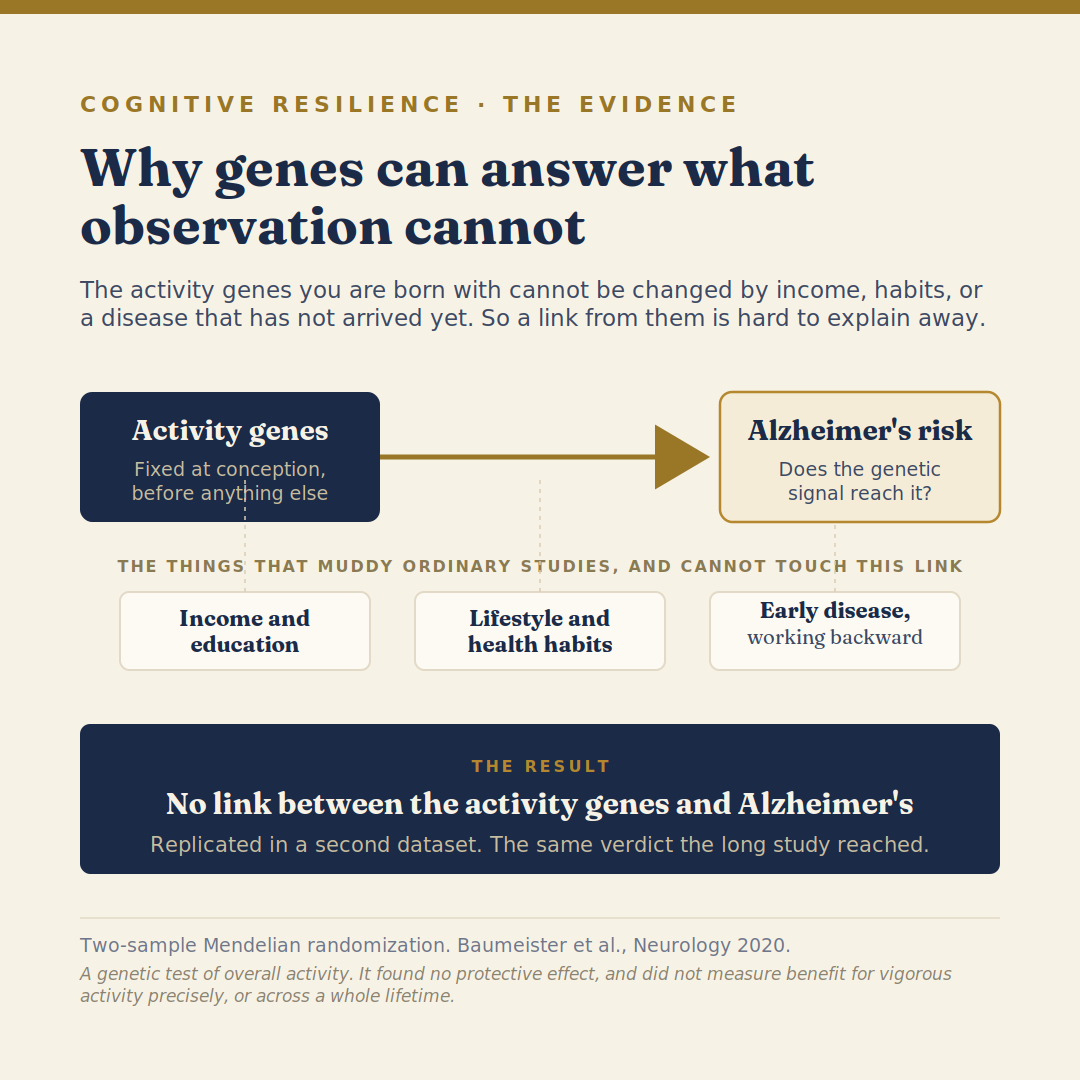
The long watch is powerful, but it is still observation. The second approach removes the problem at its root. Mendelian randomization uses the gene variants that nudge a person toward being more or less physically active. Those variants are fixed at conception, long before any disease and independent of income, education, or health, so if they also track with dementia risk, the link cannot be reverse causation and is hard to attribute to the usual confounders. It is the closest thing to a randomized trial that genetics allows.
A 2020 analysis did exactly this. It used gene variants tied to physical activity that had been measured objectively, by wrist accelerometers in more than 90,000 people, rather than by self-report, and tested them against Alzheimer’s risk in a sample of nearly 22,000 cases and 42,000 controls. Genetically predicted overall activity showed no association with Alzheimer’s, an odds ratio of 1.03 with a confidence interval sitting across 1.0. The result held in a second, independent Alzheimer’s dataset.
The finding is narrower than a single number suggests, and the authors are careful about it. It is strongest for overall activity, where the estimate was precise and replicated. For vigorous activity on its own the study was underpowered, wide enough that a real benefit could not be excluded, though the replication there also pointed to no effect. And because the genetic instruments were measured in middle-aged and older adults, the result speaks best to activity in that window rather than across a whole lifetime. Within those bounds, it found no protective effect.
Two features still make it hard to set aside. The genetic instruments were objective measures, which avoids a trap that caught earlier genetic studies. Those used self-reported activity, whose gene variants overlap with cognition itself, and they produced distorted results pointing in implausible directions, some suggesting activity raised Alzheimer’s risk. And this analysis reached the same verdict as the long-watch cohort by a completely different route. The long study and the genetic test fail in different ways, so when both land on no effect, a single shared flaw is unlikely to be the reason.
What this does and does not undo
It would be easy to read this as the floor giving way, and it is not. The challenge is specific, and its limits matter as much as its force.
It bears on the general-population prevention claim, the idea that an average person’s dementia risk falls simply because they exercise. That claim is weaker than the cohort headlines suggested. The large association this series opened with, a 35 percent risk reduction in the most cited meta-analysis, is the very figure this work corrects, with the long follow-up and the genetic test both indicating it was inflated by the disease shaping behavior.
It does not touch several things this series has established. The resistance-training trials in Part 5 were randomized, so reverse causation does not apply to them, and that signal stands. The cardiovascular and metabolic benefits of exercise are not in question, and those pathways matter for the vascular share of cognitive decline. And none of this speaks to people who already have mild cognitive impairment, which is a separate and more controlled body of evidence.
What it removes is the simplest and most oversold version of the story, that exercise is a proven dementia-preventive for the general population on the strength of the cohort data. That version was carrying more weight than its evidence could bear. The benefit is real for reasons that survive this scrutiny. The reason most people believe in it does not.
The take-home. The strong link between activity and a lower dementia rate is, in large part, an effect running backward. The earliest stages of dementia reduce how much people move, beginning years before diagnosis, which makes exercise look more protective in observational studies than it is. The longest follow-up found no protective effect once this was accounted for, and the genetic evidence, using the design built to rule out reverse causation, agreed. This does not mean exercise fails the brain. The randomized resistance-training evidence and the vascular benefits hold. It means the general-population prevention claim was built on weaker ground than it appeared.
That leaves the most direct test of all, the large randomized trials that set out to prevent decline by prescribing exercise, and what they found when they reported. That is Part 7.
This is general science writing about published research, not medical advice. Decisions about exercise, particularly for anyone with a memory concern or a medical condition, belong with your own clinician.
References
- Sabia S, Dugravot A, Dartigues JF, et al. Physical activity, cognitive decline, and risk of dementia: 28 year follow-up of Whitehall II cohort study. BMJ. 2017;357:j2709. https://doi.org/10.1136/bmj.j2709
- Baumeister SE, Karch A, Bahls M, Teumer A, Leitzmann MF, Baurecht H. Physical activity and risk of Alzheimer disease: a 2-sample mendelian randomization study. Neurology. 2020;95(13):e1897–e1905. https://doi.org/10.1212/WNL.0000000000010013